For pet brands entering the travel accessories market, creating a reliable carrier involves more than choosing attractive fabrics and adding convenient storage pockets. The product must balance animal comfort, airline restrictions, structural stability, and practical use throughout the travel journey.
These challenges become especially important for OEM buyers, wholesalers, and retailers developing products for multiple markets. A design that looks suitable in product photography may encounter difficulties at airport check-in if its dimensions, ventilation, or structure have not been carefully evaluated.
This guide explores the key requirements for developing soft-sided carriers, helping brands make informed decisions before sampling and bulk production.
1. What Does “Airline Approved” Really Mean for Pet Brands?
An airline approved pet carrier bag should be designed around the requirements of its intended airline and aircraft, rather than marketed as a universally certified product. Airlines establish their own conditions for pet transport, including carrier dimensions, ventilation, pet eligibility, and under-seat storage.
According to the Federal Aviation Administration (FAA), airlines determine whether pets may travel in the passenger cabin and establish additional transport policies.
Meanwhile, the International Air Transport Association (IATA) provides standards and guidance for transporting live animals. However, IATA does not certify individual commercial pet carrier brands or models.
For B2B buyers, this distinction directly affects product descriptions, packaging claims, and customer expectations.
A question worth asking: Should pet brands promise universal airline compatibility when acceptance ultimately depends on the airline, aircraft, and individual pet?
A more responsible approach is to identify target airlines, document relevant requirements, and clearly explain the product’s intended usage and limitations.
2. Airline Requirements: Dimensions and Market Compatibility
Developing an airline compliant pet carrier begins with understanding how different airlines evaluate carrier dimensions and animal comfort.
For example, American Airlines recommends soft-sided carriers measuring up to 18 × 11 × 11 inches (46 × 28 × 28 cm). Delta Air Lines also recommends this size for most aircraft, although actual limits depend on the aircraft configuration.
| Airline | Published Soft-Sided Carrier Guidance | Additional Requirements |
|---|---|---|
| American Airlines | 18 × 11 × 11 inches (46 × 28 × 28 cm) | Secure, padded, water-repellent material and mesh ventilation on at least three sides |
| Delta Air Lines | Recommends 18 × 11 × 11 inches for most aircraft | Leak-proof construction; ventilation on three sides for domestic travel and four for international travel |
These are airline-specific examples, not a universal standard. Brands should verify the latest requirements directly through American Airlines and Delta Air Lines.
For manufacturers, the design process should consider external dimensions, structural flexibility, interior pet space, and the aircraft types commonly used in the target market.
Brands planning products for multiple regions can also consult our airline pet carrier size guide for additional sizing and sourcing considerations.
A product intended for U.S. domestic flights may not automatically satisfy the requirements of every international route. Identifying the primary market before tooling and sampling can reduce expensive design revisions.
3. Under-Seat Engineering: Balancing Flexibility and Pet Comfort
The main engineering challenge of an under seat pet carrier bag is achieving a compact exterior without sacrificing the animal’s usable interior space.
Soft-sided construction offers advantages because fabric panels and carefully selected support components can provide limited flexibility. However, excessive compression may reduce headroom, restrict movement, or obstruct ventilation openings.
Flexible Top Structure
Instead of relying on rigid hard-shell walls, designers can use carefully positioned flexible support stays, reinforced fabric edges, and controlled folding sections.
The goal is to maintain the carrier’s intended shape during normal use while allowing limited adjustment where airline rules permit.
Stable Base Construction
The bottom panel must distribute the pet’s weight without excessive sagging. A removable base insert, suitable cushioning, and reinforced bottom seams can improve stability during carrying.
Brands should also evaluate how the base affects the final exterior dimensions.
An airline approved pet carrier bag must balance the intended airline’s space restrictions with sufficient interior room for an appropriately sized animal to move and rest naturally.
Exterior Dimensions Matter
Handles, exterior pockets, zipper tracks, and protruding attachments should be considered when evaluating the complete product profile.
For an under seat pet carrier bag, even a well-designed main compartment may become unsuitable if bulky exterior details prevent proper placement beneath the seat.
For further structural development considerations, explore our guide to collapsible pet carrier design.
4. TSA Screening Requirements: What Brands Should Actually Know
The term TSA pet carrier size frequently appears in online searches, but TSA does not establish a universal dimensional approval standard for carriers traveling inside aircraft cabins.
In the United States, TSA is responsible for security screening, while airlines establish their own pet carrier policies.
According to TSA travel guidance, travelers with pets should bring a leash to facilitate screening. At the checkpoint, passengers generally remove their pets from the carriers so that the empty bags can be screened separately.
From a product development perspective, brands should consider the following:
- Secure, accessible openings for safely removing and returning pets.
- Reliable zipper closures that help prevent accidental escape.
- Convenient carrying handles during security procedures.
- Easy-to-clean interior materials.
- Simple storage arrangements that do not interfere with screening.
Pet animals must never be placed through an airport baggage X-ray machine.
Instead of advertising a specific TSA pet carrier size certification, brands should explain how the product’s features support practical airport use and provide accurate information about applicable airline restrictions.
For retailers, which creates more customer trust: an unsupported approval claim or clearly documented product dimensions and intended airline compatibility?
5. Soft-Sided Materials: Strength, Flexibility, and Comfort
A well-designed soft airline pet carrier combines flexible fabric construction with sufficient support to maintain a safe, usable enclosure.
Material selection affects weight, airflow, cleaning convenience, product appearance, and manufacturing cost.
Exterior Fabric Selection
Polyester and nylon are common options for soft-sided travel carriers. Depending on product positioning, brands may select water-repellent woven fabrics, reinforced Oxford materials, or lightweight technical textiles.
The final material choice should account for abrasion resistance, flexibility, and the intended weight capacity.
For more detailed comparisons, see our article on lightweight pet carrier materials.
Mesh and Ventilation Materials
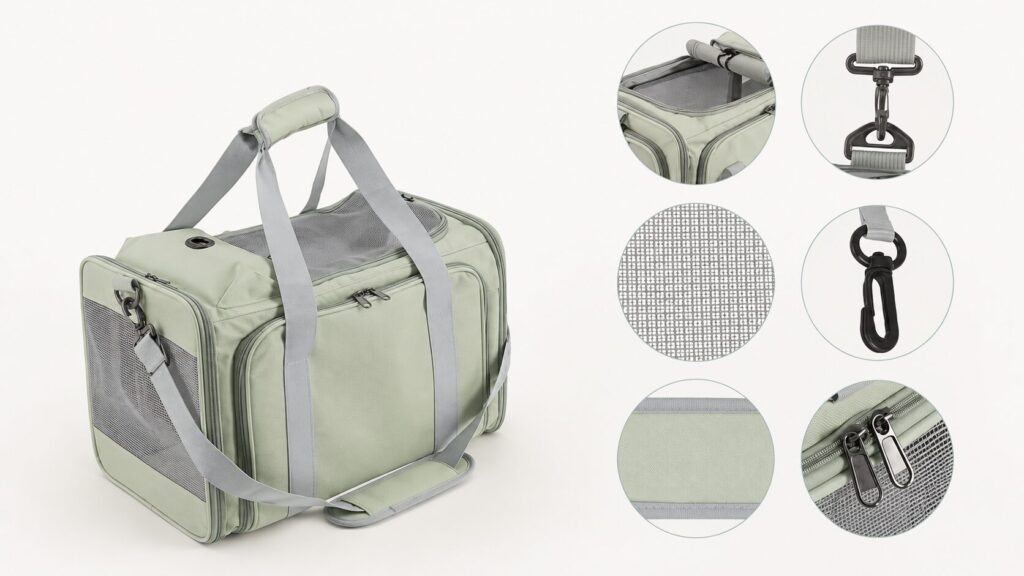
Breathable mesh panels are essential to airflow, but their placement requires careful planning.
Fine-mesh construction should be evaluated for claw resistance, tear strength, opening size, and attachment-seam durability.
Interior Padding and Linings
Removable padded mats can improve comfort and make cleaning easier. Moisture-resistant or leak-resistant lining systems may also help contain minor accidents.
However, surface water resistance alone does not establish that the complete carrier is leak-proof. Seams, corners, and base construction must also be evaluated.
A soft airline pet carrier should maintain the right balance between low weight, secure enclosure, practical cleaning, and pet comfort.
Brands can review our soft-sided pet carrier design guide for additional product development considerations.
6. Ventilation, Safety, and Escape Prevention
Ventilation and enclosure security should be treated as core engineering requirements, not optional selling features.
Effective in cabin pet carrier design should account for how air moves through the enclosure during normal use and when the carrier is positioned underneath an aircraft seat.
Multi-Sided Ventilation
Mesh panels on several sides can create alternative airflow paths. This is particularly important when part of the carrier is positioned near seat supports or surrounding objects.
Delta, for example, specifies ventilation openings on three sides for domestic travel and four sides for international travel.
Brands should avoid assuming that a large mesh window on one side provides sufficient ventilation for every airline.
Escape-Resistant Closures
Zippers, sliders, seams, and access panels must remain secure throughout transportation.
Dual-slider zippers with suitable security features can be considered, provided that the design allows owners to open the carrier quickly when necessary.
Internal tether attachments may be useful during controlled loading or other appropriate situations, but they must not replace the carrier’s secure enclosure or create an entanglement hazard.
Leak Resistance and Interior Safety
The interior should be smooth and free from sharp hardware or exposed structural components.
Leak-resistant bases, properly designed seam construction, and absorbent removable bedding help address hygiene requirements.
The IATA guidance for passengers traveling with dogs or cats emphasizes appropriate container sizing, security, ventilation, and animal welfare.
For wholesale buyers, these requirements should be reviewed during prototype development rather than after mass production.
7. Airport-Friendly Features: What Adds Real Product Value?
Beyond meeting basic requirements, thoughtful in cabin pet carrier design can improve the travel experience and create stronger product differentiation.
Consider the complete journey: home, airport transfer, check-in, security screening, boarding, and arrival.
Practical features may include:
- Padded shoulder straps: Improve carrying comfort during airport transfers.
- Reinforced handles: Provide reliable hand-carrying options.
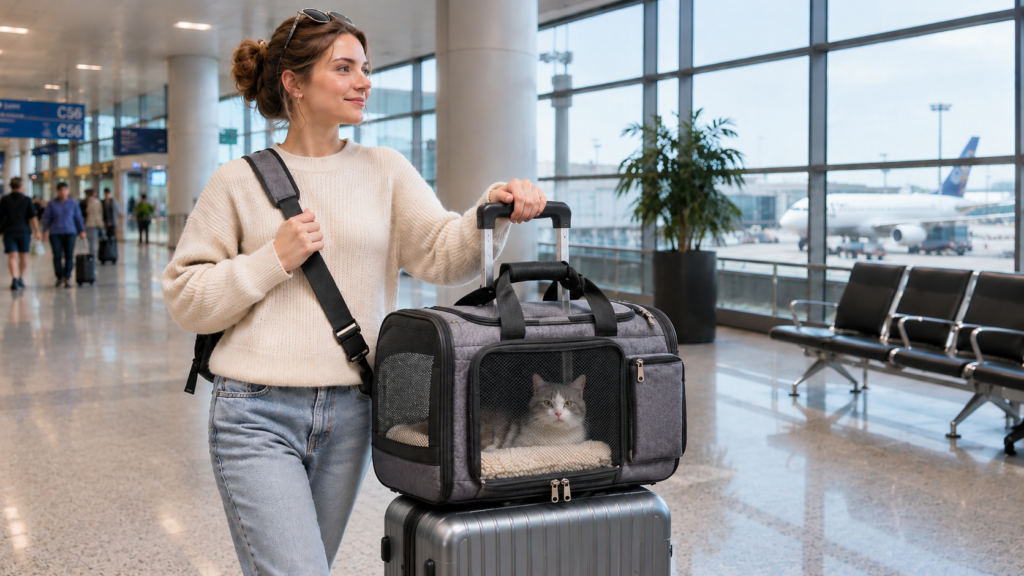
- Luggage trolley sleeve: Allows the carrier to be positioned on compatible rolling luggage when walking through the airport.
- Removable cushion: Supports cleaning and routine maintenance.
- Compact exterior pockets: Hold small essentials without creating excessive bulk.
- Secure zippered access: Makes loading and unloading easier while reducing escape risks.
However, features should not be added solely because competing products include them.
An airline compliant pet carrier must still prioritize safe enclosure, ventilation, usable pet space, and intended airline restrictions.
For example, an expandable side panel may provide additional space while the carrier is stationary, but it must remain securely closed when the airline requires a compact stowed configuration.
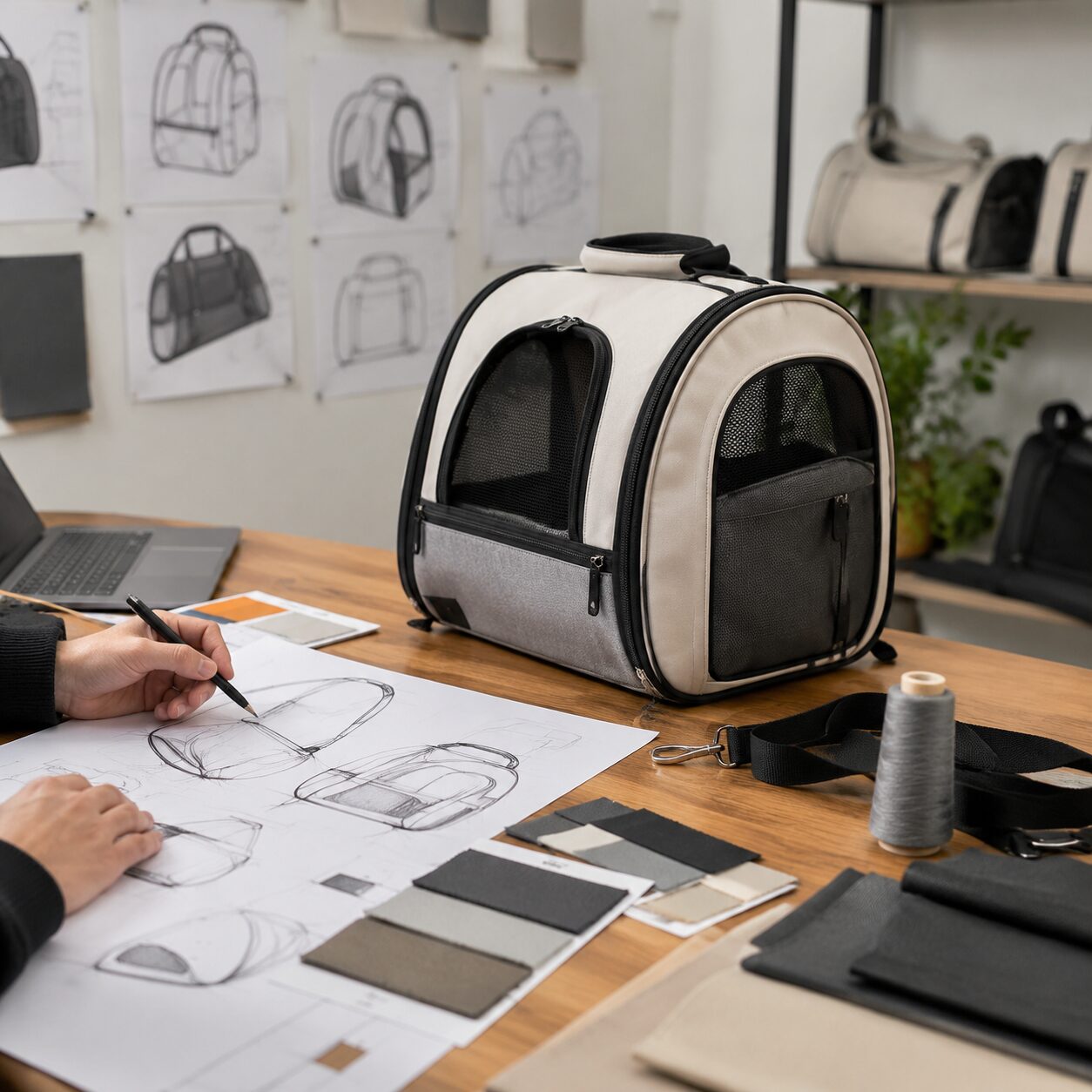
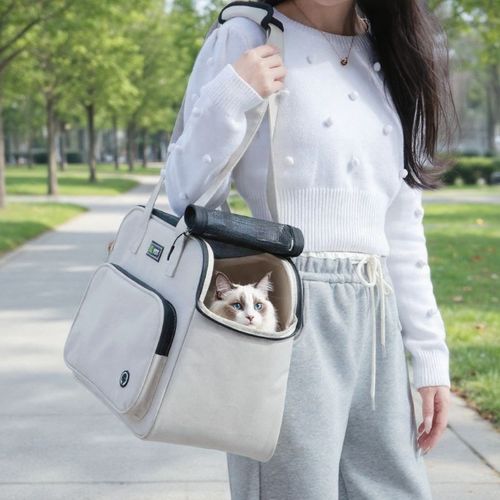
Our Compact Mesh-Window Pet Travel Carrier illustrates several possible soft-sided travel features, including mesh ventilation, zippered access, and a luggage sleeve. Its suitability for any particular flight must be separately assessed.
Would your target customers prefer more storage pockets, or a lighter carrier with better internal space and fewer unnecessary attachments?
This question can help brands prioritize genuinely useful features over design complexity.
8. Illustrative B2B Sourcing Scenario: Developing a Carrier for a U.S. Retail Collection
We manufacture for a US-based pet supplies brand that is planning to develop a line of private-label travel products for online retailers and regional pet stores.
The buyer initially requests an airline approved pet carrier bag with a fashionable exterior, multiple storage pockets, and an expanded interior.
The proposed sample measures 48 × 32 × 29 cm. While this provides useful space for accessories, its external dimensions exceed the 46 × 28 × 28 cm soft-sided guidance published by American Airlines and recommended by Delta for most aircraft.
The Product Development Challenge
The brand has to decide whether to maintain its preferred dimensions or revise the structure for closer alignment with the selected airline guidelines.
Instead of simply reducing the entire bag proportionally, the proposed development plan addresses specific areas:
- Redesign the exterior pockets to reduce unnecessary protrusions.
- Adjust the upper structure while preserving appropriate interior pet space.
- Review the ventilation layout after changing the panel dimensions.
- Evaluate lighter reinforcements and a removable padded base.
- Test the revised sample with appropriately sized pets and the target under-seat space constraints.
The buyer then considers a soft airline pet carrier in a more compact configuration, with an intended pilot order of 100 units before committing to a larger wholesale assortment.
What This Example Teaches Brands
Reducing exterior dimensions is not automatically an improvement if it leaves the intended pet unable to move comfortably.
The correct sourcing decision is to evaluate carrier dimensions, animal suitability, ventilation, and structural integrity together.
For a B2B buyer, a carefully defined product specification is more valuable than a broad compatibility claim that cannot be substantiated.
9. OEM/ODM Manufacturing: From Sample Development to Bulk Production
Turning an airline approved pet carrier bag concept into a consistent wholesale product requires more than an attractive prototype.
Brands should work with manufacturers that understand soft-sided construction, functional materials, pattern development, and production consistency.
Define the Product Specification
Before sampling, buyers should confirm:
- Target airlines and geographic markets.
- Required exterior dimensions and measurement methods.
- Intended pet size and maximum carrying weight.
- Ventilation layout and mesh specifications.
- Outer fabrics, lining, padding, and base structure.
- Zipper configuration and escape-prevention details.
- Logo application, colorways, packaging, and labeling.
Evaluate Physical Samples
A comprehensive sampling review should include dimensional measurements, carrying tests, seam and handle strength, zipper operation, ventilation accessibility, and stability under the intended load.
For an airline compliant pet carrier, buyers should also review relevant airline rules and confirm the physical sample against their target travel conditions.
Sample approval should never be treated as proof that every airline will accept the finished product.
Maintain Consistency During Production
Even when the approved prototype meets the target specifications, cutting, sewing, padding, and material variation can affect finished dimensions.
Manufacturers should define measurable tolerances and inspection criteria before production.
As an experienced OEM/ODM pet bag manufacturer, Aimazing Bag supports custom soft-sided carrier development, including material selection, structural adjustments, logo customization, sampling, and bulk manufacturing.
Our approach to in cabin pet carrier design focuses on helping brands evaluate product functionality and manufacturability alongside their commercial goals.
Explore our custom pet carrier manufacturing solutions to discuss your next private-label or wholesale travel collection.
Conclusion: Design for Practical Compatibility, Not Just Marketing Claims
Successful pet travel products balance airline requirements, animal comfort, structural durability, and manufacturing consistency.
For brands, wholesalers, and retailers, the most effective strategy is to define the target market, verify relevant airline policies, evaluate physical samples, and communicate product limitations accurately.
The question is not simply whether a carrier looks ready for air travel. It is whether your brand has the design evidence and product specifications needed to support its claims.
A thoughtful soft-sided carrier can provide a competitive foundation for a pet travel collection while helping buyers make more informed sourcing decisions.