Softness alone does not make a successful pet bedding product. A cushion may look appealing in photographs, yet its fabric can trap heat, the filling may flatten after repeated use, or the entire surface may shift when placed on a smooth floor.
For pet brands, wholesalers, and distributors, these details influence more than customer satisfaction. They affect product positioning, manufacturing consistency, return risks, and the ability to build a recognizable bedding collection.
Developing a competitive product therefore requires a balance of feline sleeping behavior, material engineering, practical maintenance, and repeatable production. This guide explores how manufacturers and buyers can turn these requirements into market-ready products.
1. Understanding Feline Sleeping Behavior Before Product Development
Resting Preferences Influence Product Design
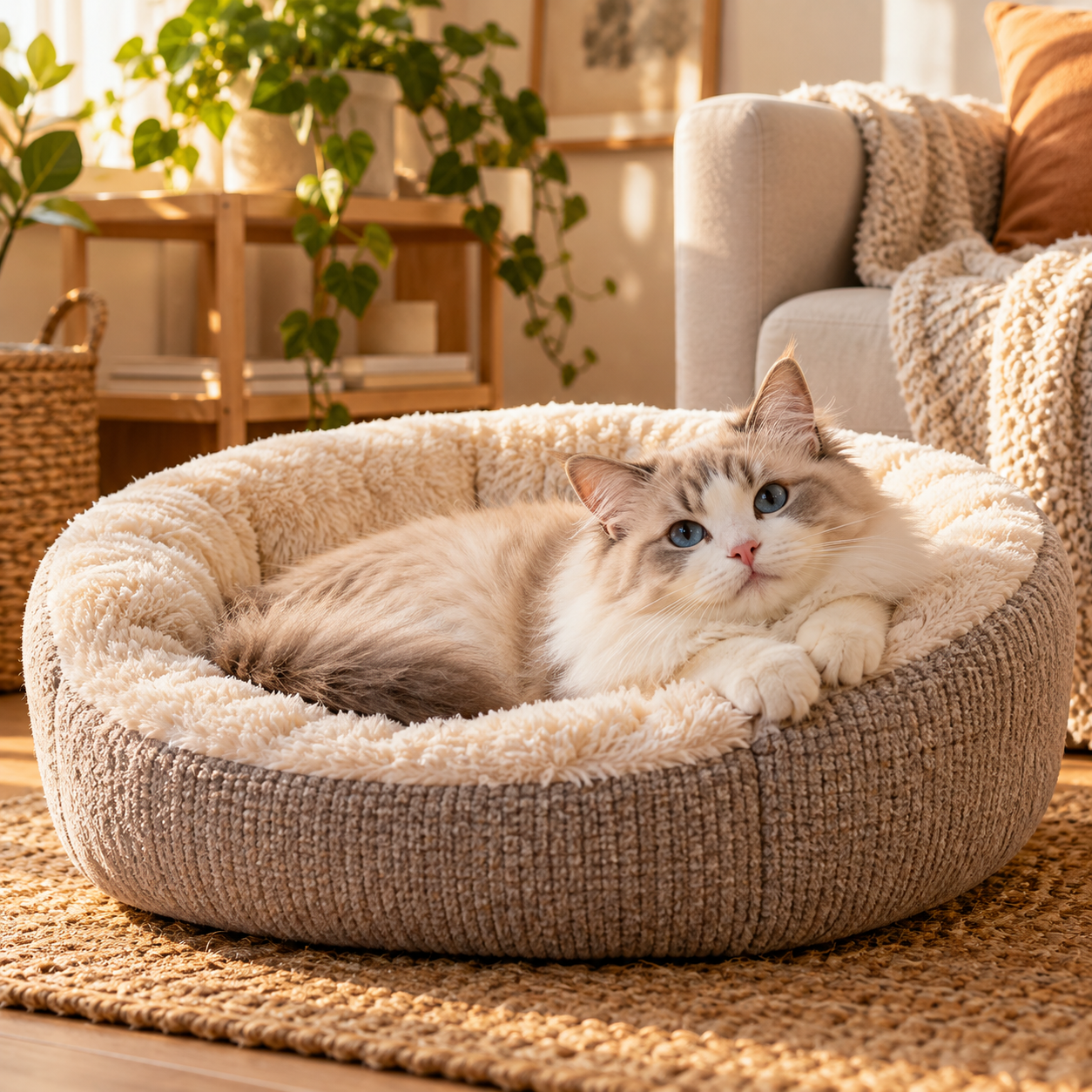
Cats do not all rest in the same position. Some curl into compact shapes, while others stretch out, change positions frequently, or prefer resting against a soft surface.
The Ohio State University Indoor Pet Initiative explains that cats tend to seek quiet, comfortable, secure resting locations. This highlights why product development should consider both the sleeping surface and the environment in which it will be used.
For brands, a cat sleeping pad should be designed around its intended location, the animal’s resting posture, and the practical expectations of the owner.
Important development considerations include:
- Sleeping position: Enough usable space for curling, stretching, and repositioning.
- Surface texture: Comfortable fabrics without excessive roughness or loose fibers.
- Thermal comfort: Suitable insulation or breathability for the target environment.
- Stability: A base that minimizes movement on common household surfaces.
- Accessibility: A low-profile structure that is easy to enter and leave.
Why Different Cats Need Different Designs
Kittens, adult cats, and senior cats may benefit from different combinations of cushioning, surface texture, and accessibility.
For example, a senior cat with reduced mobility may find a low-profile cushion easier to access than a deeply recessed bed with high sides. An active indoor cat may benefit from a lightweight design that can be placed in several favorite resting locations.
Rather than offering one universal design, pet brands can develop a small collection based on identifiable use cases.
2. Choosing the Right Shape, Size, and Product Structure
Flat and Rectangular Designs
Flat cat mats for sleeping are suitable for brands seeking lightweight, versatile bedding products that can be used on floors, sofas, window perches, or inside compatible pet furniture.
A rectangular structure is relatively straightforward to manufacture and can support different combinations of fabrics, filling materials, and edge finishes.
Its main advantages include compact packaging, flexible sizing, and practical storage.
However, the lack of raised sides makes the quality of the central cushioning and bottom grip particularly important.
Reversible and Multi-Layer Designs
A reversible cat sleeping mat can provide different surface textures without requiring a completely separate product.
For instance, one side may feature soft fleece for a cozy feel, while the reverse uses smoother, more breathable fabric for warmer indoor conditions.
This structure can help brands develop versatile collections, but both surfaces must be evaluated for durability, seam stability, and cleaning performance.
Suggested Sizing for Product Development
| Design category | Initial size reference | Potential application |
|---|---|---|
| Compact | 40 × 30 cm | Small resting spaces |
| Standard | 50 × 40 cm | General indoor use |
| Large | 60 × 45 cm | Cats that prefer stretching |
| Custom-shaped | Based on specifications | Pet furniture and carrier inserts |
These dimensions are illustrative starting points rather than universal feline sizing standards. Final measurements should consider the target animal’s resting posture and the usable surface area.
Buyers developing coordinated bedding collections can also explore related construction principles in our Custom Dog Bed Design Guide.
Although the target animals differ, many considerations involving filling consistency, removable covers, and production repeatability are applicable across pet bedding categories.
3. Material Selection: Balancing Comfort, Durability, and Cost
Selecting Suitable Surface Fabrics
Fabric selection influences tactile comfort, appearance, durability, and maintenance requirements.
A custom cat sleep mat can combine different textiles to achieve a specific product position, whether the goal is a soft lifestyle accessory, a lightweight travel cushion, or a premium indoor bedding product.
Common options include:
| Material | Main characteristics | Development considerations |
|---|---|---|
| Short-pile fleece | Soft and cozy | Pilling, lint retention, wash performance |
| Polyester knit | Lightweight and versatile | Breathability, abrasion, colorfastness |
| Cotton blends | Natural-feeling texture | Shrinkage, drying time, dimensional stability |
| Nylon blends | Smooth and quick-drying options | Surface feel, snag resistance |
| 3D spacer mesh | Air-permeable structure | Compression, edge finishing |
| RPET polyester | Recycled-content textile option | Traceability and consistent material sourcing |
The most expensive fabric is not necessarily the most appropriate choice.
A premium textile with poor wash stability may create more customer complaints than a moderately priced material that performs consistently throughout normal use.
Filling Materials and Cushion Thickness
An effective cat sleeping pad needs a cushioning structure that balances softness with shape retention.
Common filling options include:
- High-resilience PU foam: Provides a defined cushioning layer, with firmness and rebound determined by the foam specification.
- Memory foam: Offers pressure-responsive cushioning, although formulation and temperature can influence its feel.
- Polyester fiberfill: Creates a soft, lightweight structure but may require internal stabilization.
- EPE foam: Provides firmer, lightweight support for selected layered constructions.
Foam thickness should be evaluated together with density, firmness, and recovery performance. A thicker insert does not automatically provide better comfort.
For product consistency, buyers should request measurable material specifications instead of relying on vague descriptions such as “extra soft” or “premium sponge.”
Evaluating Material Safety
Textile quality should also include appropriate chemical and material documentation.
For example, OEKO-TEX STANDARD 100 provides a recognized framework for testing textiles for harmful substances.
However, textile certification alone does not guarantee that a finished pet product is safe against scratching, chewing, or component detachment.
Manufacturers should additionally evaluate loose fibers, accessible filling, sharp components, residual odors, and the security of seams and attachments.

4. Cooling and Seasonal Comfort Engineering
How Cooling Fabrics Differ From Gel-Filled Designs
A cool mat for cats is not necessarily an actively refrigerated product.
Different cooling constructions work through different mechanisms, and buyers should understand those differences before making retail performance claims.
Common approaches include:
1. Cool-touch textile surfaces
Selected nylon or polyester blends can provide a cooler initial contact sensation because of their surface properties and heat-transfer behavior.
However, the sensation may decrease as the textile approaches the cat’s body temperature.
2. Breathable layered structures
Air-permeable fabrics and spacer layers can support airflow and moisture management.
The effectiveness of the finished construction depends on the entire material combination rather than the top fabric alone.
3. Gel- or water-based constructions
These designs may provide a different cooling experience, but require additional attention to puncture resistance, sealing, leakage, cleaning restrictions, and material safety.
Choosing Between Summer and All-Season Products
For seasonal product development, brands should decide whether to create separate summer and winter models or a reversible design.
A lightweight summer version may use breathable fabric with limited insulation. A winter-oriented version could feature a plush upper layer with a softer cushioning structure.
A reversible all-season model can simplify the product range, but its construction must prevent shifting between the internal layers.
Importantly, manufacturers should not promise specific cooling temperatures or durations without suitable testing of the finished product.
For brands targeting multiple climates, documented performance and realistic product descriptions are more valuable than exaggerated cooling claims.
5. Washability, Waterproof Protection, and Everyday Durability
Designing Removable and Washable Covers
For retail buyers, cleaning convenience is an important aspect of product value.
When developing a cat sleeping pad, manufacturers should consider whether the entire item can be washed or whether the outer cover should be separated from the filling.
A removable-cover structure can offer several advantages:
- Easier cleaning without saturating the internal foam.
- Better preservation of cushioning materials that are not suitable for machine washing.
- Opportunities to supply replacement covers.
- Greater flexibility for color and pattern variations.
However, removable construction introduces its own design requirements.
Zippers should be positioned away from the primary resting surface, with pullers concealed or secured to reduce scratching and chewing risks.
Manufacturers should also confirm that the cover remains easy to remove and reinstall after repeated washing.
Waterproof Versus Water-Resistant Construction
Water-resistant fabric and a fully waterproof finished product are not interchangeable.
A coated textile may repel occasional moisture, but stitching holes, edge seams, and zipper openings can still permit liquid penetration.
For brands targeting senior-pet products or easy-clean home accessories, a separate moisture-resistant inner layer may be more practical than relying entirely on the outer cover.
The final construction should be tested according to its intended claims.
Bottom Grip and Stitching Durability
An unstable base can make an otherwise comfortable cushion inconvenient to use.
Non-slip backing options include textured polyester, silicone-dot coatings, and selected rubberized materials.
Buyers should check grip on relevant surfaces, coating adhesion, resistance to repeated cleaning, and potential floor-marking issues.
Stitching should also be reviewed for seam strength, exposed thread ends, and decorative elements that might become loose during use.
These details may not be the most visible features in product photographs, but they help determine whether the product remains practical after purchase.
6. Customization Strategies That Help Pet Brands Stand Out
Building a Recognizable Product Collection
For brands entering competitive pet bedding categories, differentiation does not always require an entirely new structure.
Coordinated colors, signature textures, custom dimensions, and distinctive edge treatments can help create recognizable collections while maintaining manufacturing efficiency.
Rather than selling generic cat mats for sleeping, brands can organize their assortments around specific customer needs.
Examples include:
- Minimalist indoor collections in neutral colors.
- Seasonal collections using different fabric surfaces.
- Travel-oriented designs with foldable constructions.
- Premium home collections with coordinated pet furniture.
- Easy-clean designs featuring removable covers.
Logo Placement and Branding Details
Buyers commissioning a custom cat sleep mat should consider branding during pattern development rather than treating it as a final decorative step.
Common customization options include woven labels, embroidery, printed care labels, and coordinated retail packaging.
Logo placement matters because raised stitching or hard decorative pieces may interfere with the resting surface.
A woven label positioned along the exterior edge, for example, can provide recognizable branding without adding unnecessary texture to the center of the cushion.
Creating Coordinated Pet Product Sets
A consistent material and color strategy can extend beyond bedding.
Pet brands may develop matching carrier cushions, travel accessories, blankets, and other soft goods to create a connected product family.
For brands already selling transport products, removable cushioned inserts may be especially relevant.
Our Custom Pet Carrier Bag Manufacturer page illustrates the wider opportunities for coordinating fabrics, linings, dimensions, and branding across pet travel products.
The commercial advantage comes from creating complementary products with consistent design language, rather than simply adding more unrelated items to a catalog.
7. Illustrative OEM Project: Developing a Better Bedding Collection
Among the companies we have worked with is a European pet supplies brand that is preparing to launch a line of compact pet bedding products through its online store and wholesale partners.
The initial concept is a simple rectangular cushion measuring 45 × 35 cm, using polyester fabric, lightweight filling, and a small woven logo.
The brand has received a basic quotation from a supplier offering a standard construction with color changes.
However, the buyer is concerned that the product may be difficult to distinguish from similar wholesale listings.
The buyer also asks whether a cool mat for cats can be developed as a complementary summer product without introducing the leakage concerns associated with some filled cooling designs.

The Limitations of a Quote-Only Approach
A quotation based primarily on a reference photograph may not establish the specifications required for consistent production.
Several questions remain unanswered:
- How much filling is used in each unit?
- Does the cushioning retain its original thickness after compression?
- Can the cover be washed independently?
- Is the bottom sufficiently stable on smooth flooring?
- Are the materials available for repeat orders?
- Which features can be customized without significantly increasing cost?
Without clearly defined requirements, two factories may appear to offer an identical product while quoting different materials and construction quality.
A Product-Development Approach
Instead of simply reproducing the original reference, an engineering-focused manufacturer could propose three design improvements.
Improvement 1: A more consistent cushioning structure
Replace loosely distributed filling with a defined foam insert or stabilized padding construction, depending on the target comfort and cost.
A proposed prototype might use a 2 cm cushioning layer, with final thickness and firmness determined through sample evaluation.
Improvement 2: A removable and washable outer cover
Introduce a concealed zipper and a removable fabric cover.
This provides a clear maintenance feature while allowing the brand to evaluate cover durability separately from the inner cushion.
Improvement 3: A coordinated seasonal variation
Develop a second surface specification using a suitable cool-touch textile rather than automatically selecting a gel-filled construction.
The summer version can retain the same core dimensions and branding approach, simplifying the visual consistency of the collection.
Comparing Two Development Approaches
| Evaluation point | Basic specification-copying approach | Engineering-led OEM approach |
|---|---|---|
| Product size | Exterior measurements only | Exterior and usable surface dimensions |
| Filling | General material description | Defined thickness, density, and structure |
| Cleaning | Basic care claim | Construction-specific washing evaluation |
| Cooling | Broad marketing description | Material selection supported by testing |
| Branding | Logo added to an existing product | Brand details integrated into design |
| Bulk production | Visual reference | Approved sample and written specifications |
This comparison describes two sourcing approaches, not verified performance differences between named manufacturers.
What Makes the Development Process More Valuable?
The key difference is not the addition of expensive materials.
It is the ability to identify potential usability and manufacturing problems before bulk production begins.
A development partner can explain trade-offs, compare construction alternatives, and help the buyer decide which improvements justify additional material or production costs.
For brands, this process can produce clearer product differentiation, more predictable specifications, and a stronger foundation for future collection development.
The actual commercial benefits still depend on prototype testing, final quotations, consumer response, and production execution.
8. From Product Concept to OEM Mass Production
Step 1: Define the Product Brief
Before sampling, buyers should identify the intended use, target market, design style, estimated order quantity, and target price.
The brief should include:
- Product dimensions and tolerances.
- Fabric composition and surface requirements.
- Filling material and thickness.
- Bottom construction and grip requirements.
- Branding and packaging specifications.
- Cleaning instructions and intended performance claims.
A complete brief enables suppliers to offer more comparable quotations.
Step 2: Develop and Evaluate Prototypes
When evaluating cat sleeping mat samples, brands should look beyond appearance.
Important checks include:
- Actual dimensions versus the approved drawings.
- Cushion thickness and compression behavior.
- Fabric appearance after washing.
- Seam strength and edge finishing.
- Bottom stability during everyday placement.
- Ease of removing and reinstalling covers.
- Product condition after folding or packaging.
Any changes should be documented before the reference sample is approved.
For more information about the development workflow, see our article on Developing Custom Pet Bags From Idea to Sample.
Step 3: Confirm the Production Specifications
Once the sample is approved, the manufacturer should establish a clear bill of materials and production specification.
Fabric weights, foam properties, cutting dimensions, filling quantities, stitch requirements, label positions, and packaging methods should be recorded.
These specifications help reduce unexpected differences between the approved prototype and the production batch.
Step 4: Prepare for Bulk Production
Before production begins, buyers and manufacturers should confirm material availability, color approvals, packaging requirements, inspection criteria, and the delivery schedule.
For projects with multiple variants, shared components can sometimes reduce sourcing complexity.
However, changes in fabric type, foam thickness, or product size may require separate testing and revised production instructions.
A reliable development process should support not just the first order, but consistent repeat production.
9. Working With Aimazing as Your Pet Product Development Partner
Selecting an OEM manufacturer involves more than comparing unit prices.
Brands need a partner capable of translating product ideas into practical specifications while considering manufacturing feasibility, comfort, cost, and consistency.
At Aimazing, we support pet brands, wholesalers, and distributors with OEM/ODM product development, material sourcing, sampling, customization, and bulk manufacturing.
Our experience in soft-sided pet products provides a foundation for developing customized cushions, bedding accessories, and coordinated pet product collections.
Our Development Capabilities
Material and structure customization
We support material combinations based on the intended application, including woven textiles, soft-touch fabrics, cushioning layers, and selected moisture-resistant materials.
Sampling and design refinement
Our sampling team works from customer drawings, reference samples, and technical requirements. Sampling for suitable projects can typically be completed within 3–5 days, depending on design complexity and material availability.
Branding and packaging
We support customized colors, logos, woven labels, care labels, and retail packaging to help brands develop consistent product presentations.
Flexible OEM/ODM cooperation
Our standard minimum order quantity starts from 100 pieces for many custom projects, subject to specific materials and production requirements.
Manufacturing coordination
We help customers review specifications, confirm samples, and organize production requirements before moving into bulk manufacturing.
Explore our Pet Accessories Manufacturing Solutions or learn more about our Customization Process.
Conclusion
Developing a successful cat sleeping pad requires more than selecting attractive fabrics and adding a logo.
Surface comfort, internal cushioning, cleaning convenience, construction stability, and manufacturing repeatability all contribute to the finished product’s value.
For pet brands seeking to build differentiated bedding collections, the right OEM partner should help identify practical design improvements and translate them into measurable, production-ready specifications.
Looking to develop your own custom pet bedding collection?
At Aimazing, we work with pet brands, wholesalers, and distributors to turn product concepts into manufacturable designs.
Share your design ideas, material preferences, and target market with our team, and let’s explore how to develop a product that fits your brand.
Your Pet Product Development & Manufacturing Partner.