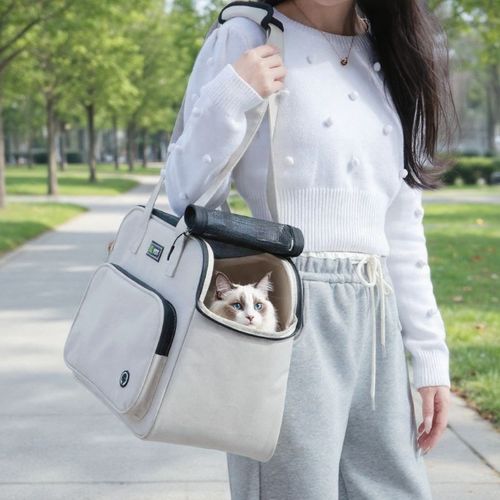
Small pet accessories often succeed because they balance a distinctive look with everyday practicality. For brands, however, turning an appealing concept into a sellable collection requires more than choosing a cute shape or matching colors. The product must respect feline movement, be easy for owners to fit, and remain consistent across production batches. This guide looks at the design and sourcing decisions behind a miniature pack worn by the cat itself.
1. What Are You Actually Developing: A Cat-Worn Pack or a Carrier?
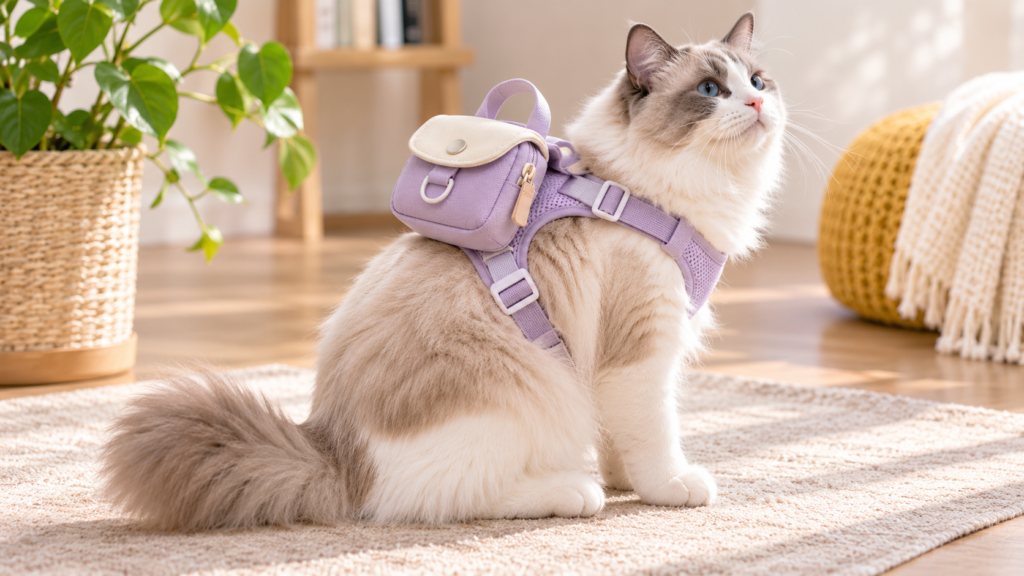
A cat-worn mini backpack is a small pouch positioned on a cat’s back, usually supported by a harness-style strap system. The cat wears the accessory; the cat does not sit inside it. That distinction changes the design brief completely. The key questions become how the pouch attaches, how little it weighs, and whether it interferes with walking, crouching, grooming, or resting.
For pet brands, this belongs closer to the wearable accessories and harness category than the travel-carrier category. A decorative mini pouch may be a more appropriate starting point than a functional cargo bag. Before finalizing features, define whether the product is intended for supervised photo sessions, short periods of indoor wear, or limited, carefully introduced outdoor use.
2. Should Cats Carry Anything at All?
This is the first product-development question buyers should ask, not an objection to address after the design is finished. Cats differ widely in their tolerance of harnesses and unfamiliar items on their bodies. The animal-welfare organization Cats Protection advises gradual, positive introduction if a harness is used and cautions that many cats find restraint stressful.
Brands should therefore avoid advertising a backpack for a cat to wear as essential exercise equipment or suggesting every cat will enjoy it. Start with an extremely light, preferably empty pouch; treat storage capacity as a design limit, not a selling promise. Avoid publishing a universal safe carrying-weight percentage without product-specific assessment and qualified veterinary input.
The end-user instructions should tell owners to supervise use, introduce the item gradually, stop if the cat freezes or shows distress, and remove it after the session. Such guidance is part of responsible product development, not merely packaging copy.
3. Fit and Balance: Can a Small Pouch Stay Stable Without Restricting Movement?
When developing a tiny backpack for cat to wear, manufacturers should begin with the cat’s body measurements and movement range—not the dimensions of a scaled-down human backpack. Chest girth, neck clearance, back length, and shoulder mobility all affect where the pouch can sit.
A practical prototype review should examine:
- Placement: The pouch sits centrally on the upper back without pressing into the neck or shifting toward the tail.
- Attachment: Adjustable straps and secure stitching limit rotation without excessive tightness.
- Movement: The design does not block the front legs, shoulder blades, or normal crouching.
- Contact surfaces: Soft binding, covered seams, and smooth strap edges reduce rubbing points.
- Fitting instructions: Illustrated size measurements help owners choose and adjust the right fit.
A suitable starting reference is our Cat Safe Dual-Point Walking Harness Set, which illustrates adjustable straps and padded contact areas. It is a harness reference, not an existing cat-worn backpack model; a pouch attachment would require its own development and testing.
4. Miniature Styles for Different Retail Positions
A mini backpack for cat to wear can be developed in several directions, but each should have a clearly defined reason to exist in your assortment.
| Concept | Design Direction | Brand Opportunity |
|---|---|---|
| Minimal flat pouch | Low-profile shape, simple closure, soft body-facing panel | Everyday lifestyle accessories |
| Character-inspired mini pack | Light fabric appliqué or embroidery instead of bulky ornaments | Seasonal or gift collections |
| Removable decorative pouch | Pouch attaches to a separately fitted harness | Mix-and-match colors or coordinated sets |
| Outdoor-look mini pack | Technical-looking fabric and understated trim, without implying heavy-load use | Premium adventure-style branding |
For a first launch, two colorways on one approved base pattern may be easier to manage than several different shapes. The biggest design risk is not a lack of novelty; it is adding details that look attractive in a product photo but create bulk, swinging movement, or discomfort in real wear.
5. Materials: Lightness Matters More Than a Rugged Appearance
For this type of feline wearable, material selection should start with weight, flexibility, breathability at the body-contact area, and the ability to keep seams smooth. Stiff fabric and excessive padding can make a miniature pouch feel disproportionately bulky.
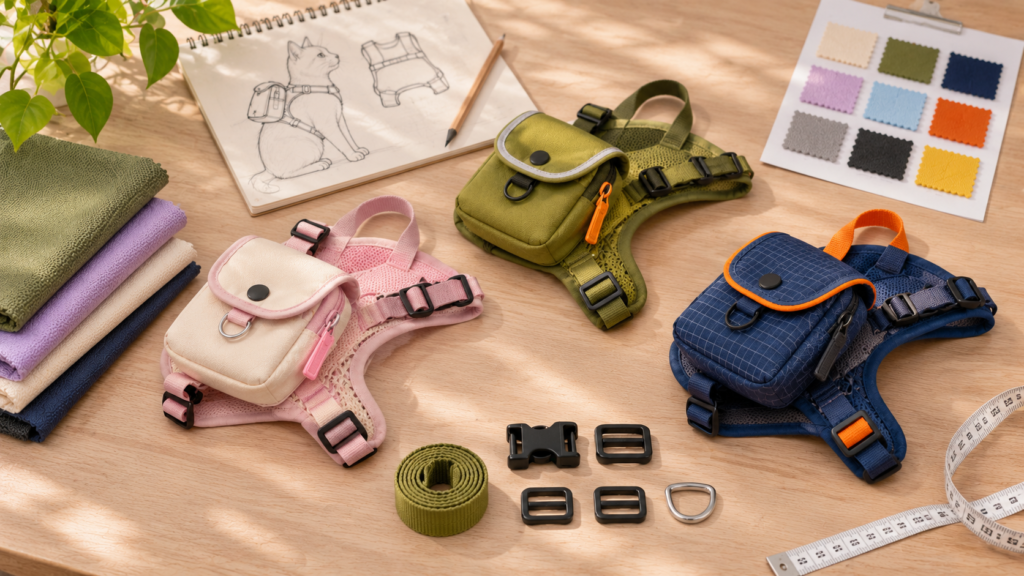
Useful materials to evaluate include lightweight polyester or nylon for the outer shell, soft mesh for selected contact panels, thin webbing for adjustable straps, and low-profile plastic buckles where suitable. RPET may be an option for brands with recycled-content goals, subject to supplier documentation and the finished product’s performance needs.
Zippers, pullers, patches, and decorative elements deserve particular scrutiny. A small metal charm may add more weight and noise than the design warrants. Favor secure attachments, no accessible loose pieces, and washable or wipe-clean surfaces. For related customization options, see our pet harness manufacturing collection.
6. Is a Cute Product Photo Enough to Justify a New SKU?
The image of a cat with backpack on can attract attention, but visual appeal alone does not establish product demand or suitability. Brands should validate how owners respond to the fit, fastening process, product weight, cleaning instructions, and the cat’s behavior during wear.
A short concept-testing program might compare a flat embroidered pouch with a slightly structured version. Show the same harness layout, use consistent product photography, and ask prospective buyers which design they would trust and why. Where animal models are involved, use only cats that comfortably accept the accessory and avoid forcing poses for marketing content.
This is also where retail claims need discipline. Terms such as “escape-proof,” “stress-free,” or “safe for all cats” should not appear without appropriate evidence; product photos should not imply that a cat should carry toys, bottles, or other heavy items.
7. What Can Brands Customize Through OEM/ODM Development?
A backpack for a cat to wear should be treated as a coordinated soft-goods and harness project. The backpack-shaped pouch is only one component; fit, fastening, and the owner’s experience matter just as much as the exterior appearance.
Potential customization options include fabric, color matching, dimensions, pouch profile, harness webbing, buckle type, branded woven labels, embroidery, removable patch designs, and retail packaging. A brand may also develop matching leashes or harness colors to create a coherent accessories collection.
At AIMAZING’s pet accessories manufacturing page, brands can explore broader OEM/ODM capabilities. Final options, tolerances, prices, and minimum quantities should be confirmed after reviewing the actual design and sample rather than assumed from a standard catalog style.
8. Prototype Testing: What Should Buyers Check Before Approving the Sample?
A tiny backpack for cat to wear must pass more than a tabletop appearance check. Test the finished sample on appropriately sized, willing cats under close supervision, and evaluate both how the animal moves and how the straps and pouch behave. Stop the session if the cat shows discomfort; a well-sewn prototype is not automatically a well-tolerated wearable.
Before approving production, verify the intended fit range at both ends of the size chart and observe pouch stability during ordinary movement. Inspect every contact surface for rubbing edges, trapped fur, snagging points, or accessible small parts. Then check construction quality—seams, buckles, adjusters, and pouch attachments—against the product’s intended use. Finally, confirm that cleaning and fitting instructions are clear and that packaging communicates any usage restrictions.
When assessing a mini backpack for cat to wear, ask the factory to keep the approved sample, size chart, bill of materials, and workmanship standards aligned. A useful reference is our article on why a perfect pet-product sample can still become a bad bulk order.
9. From Design Brief to Bulk Order: How Do You Reduce Risk?
Brands should send a concise technical brief covering intended use, cat size range, approximate empty-product weight target, strap layout, materials, logo treatment, packaging, target price, and destination market. Add front, side, and on-cat reference views so that the factory does not mistake the concept for a human-carried pet transporter.
A development brief might describe the product as a low-profile decorative pouch with an adjustable feline harness, no heavy cargo requirement, and a removable or washable component if feasible. The proposed features still need prototype validation; they should not be presented as a guaranteed performance specification.
At AIMAZING, our broader pet bag and harness manufacturing services cover design review, material options, sampling, and production planning. Our published custom pet bag sampling process explains the development workflow. Although standard samples may be completed in 3–5 working days, a newly engineered cat-worn design may require extra fitting rounds or custom components.
10. Questions Purchasing Teams Should Ask Their Manufacturer
Before ordering, ask for sample photos from several angles, actual empty-product weight, the adjustment range for every size, and a clear description of what the pouch is designed to hold—if anything. Request the proposed test plan and agree on which performance claims your brand can substantiate.
For a cat with backpack on marketing concept, buyers should also specify how product photography will show the pouch’s real scale and its position on the animal’s back. Images showing a full-sized human backpack, a cat inside a carrier, or exaggerated storage capacity may attract the wrong audience and cause preventable returns.
A second purchasing question concerns repeatability: will the production units match the approved sample’s fabric weight, strap placement, buckle dimensions, label position, and seam finishing? For additional supplier-screening considerations, read our pet accessories manufacturer guide.
11. Build the Product Around the Cat, Not the Trend
A successful cat-worn mini backpack should be defined by thoughtful restraint: minimal weight, stable attachment, comfortable contact areas, honest product claims, and repeatable manufacturing. Decorative value can support a brand story, but it should never override the cat’s willingness to wear the item.
AIMAZING works with pet brands, importers, wholesalers, and distributors on customized pet bags, harnesses, and accessories. If your team is exploring a cat-worn mini-pack collection, share your sketches, reference images, preferred materials, and target market through our contact page. We can discuss feasibility, sample development, and a practical production plan before you commit to a bulk order.