For pet brands and wholesale buyers, entering the large-breed bedding market involves more than introducing another oversized product. Bigger dimensions affect material consumption, cushioning performance, packaging efficiency, shipping costs, and ultimately retail profitability.
Choosing the right manufacturing specifications can make the difference between a product that looks attractive in a catalog and one that performs consistently after reaching customers. From foam density to washable covers and bulk production standards, every decision influences product quality and your brand’s long-term competitiveness.
This guide explores the key considerations for sourcing and developing sleeping mats for large dogs, helping brands, importers, and distributors build practical, differentiated product collections.
1. Is Your Brand Sourcing a Sleeping Mat or Simply an Oversized Dog Bed?
Before approaching a manufacturer, buyers should establish exactly which product category they intend to sell. Although sleeping mats and traditional dog beds serve similar resting purposes, their construction, functionality, and production costs can differ significantly.
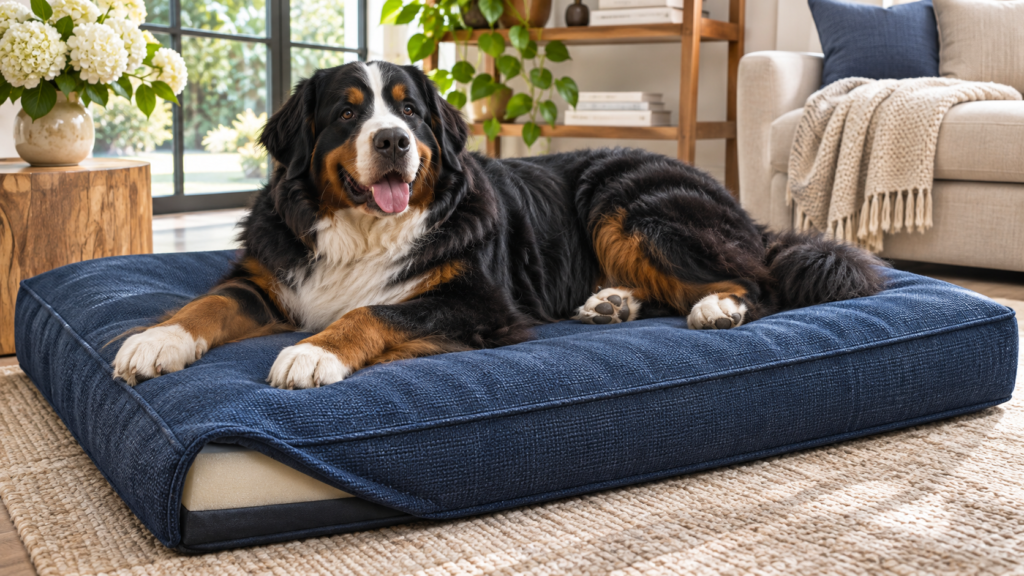
An extra large dog mat is generally designed as a flat or low-profile padded surface that provides a dedicated sleeping area for larger breeds. Unlike raised beds or heavily bolstered designs, sleeping mats emphasize usable surface area, cushioning support, easy cleaning, and placement flexibility.
For brands developing a large dog mat collection, it is important to distinguish sleeping functionality from decorative features. A product may look luxurious with thick borders and raised cushions, but those features can reduce the available sleeping area and increase shipping volume.
What should buyers consider?
- Flat sleeping surface: Provides room for dogs to stretch out without restrictive raised edges.
- Cushioned construction: Uses an appropriate filling or foam structure to provide support.
- Low-profile design: Makes the product easier to position in different indoor environments.
- Practical maintenance: Removable covers and washable materials can simplify cleaning.
- Brand differentiation: Size, materials, thickness, and design details can be adapted to different market segments.
For reference, brands can explore custom pet beds and cushion designs to understand different construction options before defining a dedicated flat sleeping-mat collection.
2. Are Your Sleeping Mat Dimensions Actually Suitable for Large Breeds?
One of the most common sourcing mistakes is treating size labels such as L, XL, and XXL as universal specifications.
There is no single dimension that suits every large dog. Body proportions, sleeping posture, and intended usage all influence the required surface area.
When developing dog mats for sleeping, brands should consider more than the animal’s weight. Some breeds prefer curling into a compact position, while others naturally stretch their legs across a wider area.
A longer surface may therefore be more suitable for certain dogs, even when two breeds have similar body weights.
How should brands develop a size range?
The following dimensions are illustrative starting points for product development, rather than universal breed-size standards.
| Proposed size | Example dimensions | Product positioning |
|---|---|---|
| Large | 100 × 70 cm | Large-breed indoor resting |
| Extra Large | 120 × 80 cm | Larger dogs requiring more sleeping space |
| XXL | 140 × 90 cm | Oversized resting areas for very large breeds |
Final dimensions should be validated against the brand’s target dogs and usage scenarios.
For buyers developing a large crate mat, interior crate dimensions become another consideration. The product must fit the actual floor area without excessive folding or compression against the crate walls.
Before confirming production, brands should request:
- Finished product dimensions and acceptable manufacturing tolerances.
- Total thickness under unloaded conditions.
- Usable sleeping area after stitching and edge construction.
- Shrinkage or dimensional changes after cleaning.
- Folded or compressed packaging dimensions.
These details help manufacturers develop consistent specifications and reduce the risk of unexpected sizing complaints.
3. Which Materials Can Balance Comfort, Durability, and Manufacturing Cost?
Material selection is one of the most important decisions in wholesale bedding development.
The outer surface of a dog sleeping mat must balance softness with everyday practicality. Although plush materials can create an attractive appearance, some fabrics may retain hair, show wear, or require more maintenance than tightly woven alternatives.
A well-designed extra large dog mat should combine an appropriate surface fabric with a cushioning structure that maintains its intended function under repeated use.
For procurement teams, the objective is not necessarily to select the most expensive material. It is to identify a construction that meets the brand’s retail positioning and measurable performance requirements.
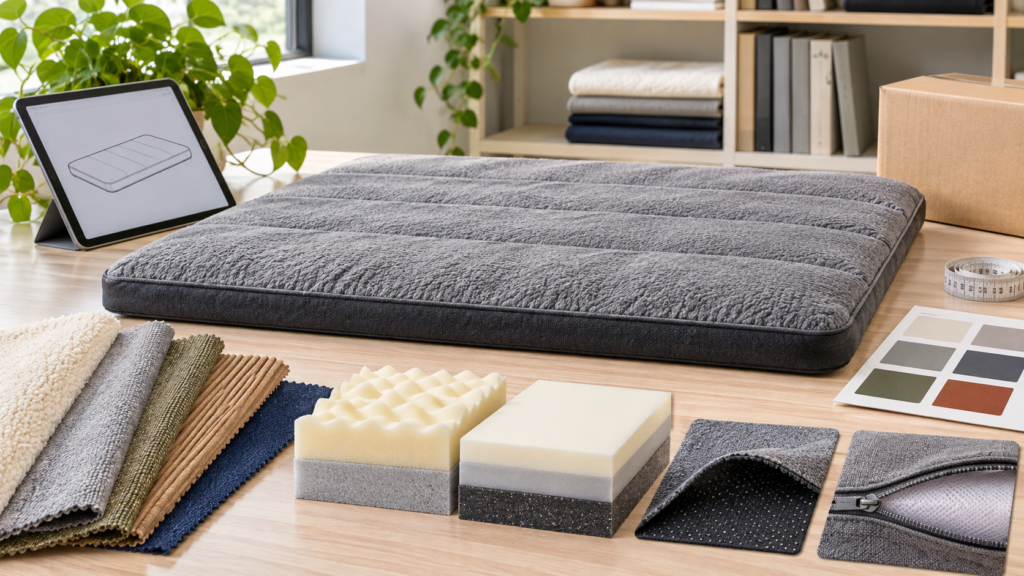
Common material options for sleeping mats
| Material | Main characteristics | Potential application |
|---|---|---|
| Oxford polyester | Durable woven surface, practical for everyday use | Standard or functional collections |
| Plush fabric | Soft surface with a comfortable texture | Indoor comfort collections |
| Corduroy | Distinctive textured appearance | Lifestyle and premium collections |
| High-density foam | Firm cushioning with potential for improved shape retention | Support-focused designs |
| Memory foam | Conforming cushioning with performance dependent on formulation | Premium padded collections |
| Non-slip backing fabric | Helps limit movement on suitable floors | Indoor sleeping areas |
Material performance depends on the complete construction, not the fabric name alone.
For example, two polyester fabrics may differ in yarn density, backing treatment, abrasion resistance, and washing performance. Similarly, foam products with identical thicknesses may perform differently because of their density and compression characteristics.
Should suppliers provide material documentation?
Yes. Brands should request relevant material specifications and testing documentation rather than relying only on verbal descriptions.
For textile-related harmful-substance testing, buyers may refer to the official OEKO-TEX® STANDARD 100 framework when evaluating applicable certified materials.
However, buyers should verify the actual certificate scope. Certification of an individual fabric does not automatically mean the finished sleeping mat is certified.
4. Does a Thicker Sleeping Mat Always Mean Better Support?
Thickness is an easily marketed feature, but it does not tell buyers everything about cushioning performance.
A thick product with low-density filling may compress considerably during use. Meanwhile, a thinner mat with a carefully selected foam construction may retain its intended shape more consistently.
For dog mats for sleeping, brands should evaluate the complete internal structure rather than using thickness alone as a quality indicator.
Which cushioning structures should buyers compare?
Single-layer foam
This construction provides a relatively simple manufacturing process. Depending on the foam specification, it may be suitable for economical or mid-range bedding collections.
Multi-layer foam
Different foam layers can be combined to achieve specific firmness and surface-feel requirements. However, additional layers increase construction complexity and should be justified through sample evaluation.
Fiber or sponge-particle filling
Loose or distributed filling can create a softer cushion-style product. Brands should examine whether the filling moves, bunches, or becomes uneven after prolonged use and repeated cleaning.
What should brands test?
Buyers can request sample evaluations covering:
- Foam thickness and density.
- Compression under a defined load.
- Shape recovery after the load is removed.
- Consistency of cushioning across the surface.
- Layer separation or filling displacement.
- Changes after repeated cleaning and use.
Any marketing claims about orthopedic support or medical benefits should be supported by appropriate evidence. A particular foam type alone is not sufficient to establish therapeutic performance.
5. Could Poor Cleaning Performance Be Costing Your Brand Repeat Orders?
Cleaning convenience can influence customer satisfaction long after the initial purchase.
Large sleeping mats are exposed to pet hair, dirt, moisture, and repeated use. For overseas brands, poorly designed cleaning features can create unnecessary complaints and returns.
Removable or fixed covers: Which makes more sense?
Removable covers
A detachable outer cover allows customers to clean the fabric separately from the cushioning insert. For manufacturers, this requires consideration of zipper placement, opening dimensions, stitching strength, and reassembly convenience.
Fixed covers
A fully sewn construction may simplify assembly and reduce component costs. However, the cleaning method depends on the filling and complete material combination.
Water-resistant surface treatments
Water-resistant fabrics can help manage light spills, but their performance depends on the treatment, fabric construction, and exposure conditions.
Brands should avoid treating water-resistant and waterproof as interchangeable claims. Even when the fabric resists liquid penetration, seams, zippers, and exposed edges may remain vulnerable.
For product development, specify the intended cleaning method before approving the fabric and internal filling.
6. What Customization Options Can Help Your Brand Avoid Generic Products?
Brand differentiation should extend beyond placing a logo on an existing design.
When sourcing a large dog mat, wholesale buyers should consider how construction and functional features can support different retail price points and target customers.
OEM and ODM development can involve adjustments to the product’s dimensions, cushioning, cover fabric, appearance, and packaging.
Key customization options
| Customization area | Available design directions | Potential commercial benefit |
|---|---|---|
| Dimensions | Custom length, width, and thickness | Targeted breed-size collections |
| Outer fabric | Polyester, plush, corduroy, textured fabrics | Different retail positioning |
| Internal cushioning | Foam type, density, and layered construction | Differentiated firmness and product feel |
| Bottom layer | Non-slip fabric or selected protective backing | Functional differentiation |
| Cover structure | Detachable or fixed construction | Different cleaning and cost options |
| Colors | Custom solid colors or coordinated combinations | Consistent brand identity |
| Logo | Woven labels, embroidery, or suitable printing methods | Private-label recognition |
| Packaging | Branded inserts, labels, retail cartons, or compact packing | Improved presentation and logistics planning |
The suitability of each option should be checked against product construction, available materials, and order volume.
Brands interested in textured cushion designs can also review this striped dog cushion product as a reference for fabric, piping, and branding details.
This example is a cushion-style bed rather than a confirmed oversized flat sleeping-mat specification; the final dimensions and structure would need separate development.
7. What Should Wholesale Buyers Check Before Approving a Sample?
Sample approval should involve more than confirming appearance.
Before approving a dog sleeping mat, brands should check whether its dimensions, cushioning, material performance, and construction match the agreed product specifications.
A visually attractive sample can still have weaknesses that become apparent after cleaning, compression, or repeated use.
A practical sample approval checklist
| Inspection item | What buyers should verify |
|---|---|
| Dimensions | Finished measurements match approved specifications |
| Foam structure | Correct type, thickness, density, and arrangement |
| Surface material | Approved texture, color, and fabric specification |
| Stitching | Consistent seams and secure edge construction |
| Cover removal | Zipper accessibility and ease of inserting or removing cushioning |
| Cushioning recovery | Performance after defined compression and recovery cycles |
| Washing | Changes to fabric, seams, size, and appearance after cleaning |
| Bottom surface | Grip performance on relevant floor types |
| Packaging | Packed dimensions, labeling, and condition after unpacking |
Testing methods, sample sizes, and acceptance limits should be agreed upon before production rather than chosen after a defect occurs.
Brands should also retain an approved reference sample and a detailed specification sheet for comparison with pre-production and bulk units.
For more information about the risks of differences between prototypes and finished production, see our article on why approved samples can still become problematic bulk orders.
8. Should Your Brand Offer Sleeping Mats for Crates as Well as Indoor Floors?
Expanding a bedding collection across different use scenarios can create additional sales opportunities, but not every sleeping surface should be marketed for every environment.
A large crate mat requires careful dimensional planning because the available space is constrained by the crate’s internal structure.
A mat designed for general floor use may be too wide, too thick, or difficult to position inside a particular crate.
Which structural features matter?
For indoor floor placement:
- Suitable cushioning for the intended breed size.
- A bottom surface compatible with common flooring.
- Practical cleaning and maintenance.
- An appropriate balance between thickness and portability.
For crate placement:
- Accurate dimensions based on the internal floor area.
- Sufficient clearance for doors and crate components.
- Edges that do not require excessive folding.
- Cushioning that remains practical within the available space.
For wholesale buyers, these may be better developed as related but distinct SKUs.
Brands can use coordinated materials and colors across both products while maintaining different dimensional specifications and functional requirements.
9. Is the Lowest Unit Price Really the Best Wholesale Deal?
Price remains important in international sourcing, but product profitability depends on more than the factory quotation.
An extra large dog mat typically consumes more fabric and cushioning material than a smaller equivalent. Its packaged dimensions can also affect freight charges, warehouse requirements, and fulfillment costs.
A low initial quotation may therefore become less competitive if it relies on unsuitable materials or inefficient packaging.
What should buyers include in their sourcing comparison?
| Cost factor | Questions to ask |
|---|---|
| Material cost | What fabric grade and foam specifications are included? |
| Manufacturing cost | How does the construction affect production complexity? |
| Packaging cost | Can packing volume be reduced without damaging the product? |
| Freight cost | What is the carton volume and expected shipping method? |
| Quality-related cost | What defects could create returns or replacements? |
| Inventory cost | How many sizes and colors should be stocked initially? |
| Reorder cost | Can the same specifications be repeated consistently? |
For example, vacuum compression may reduce packed volume for some suitable foam constructions. However, it can also affect recovery performance or require additional unpacking time.
Manufacturers should validate the packaging method through practical trials rather than assuming every material can be compressed safely.
Procurement teams comparing potential partners may also benefit from our guide on evaluating pet product suppliers by price, quality, and lead time.
A useful quotation should make the product specifications, packaging assumptions, and commercial terms clear enough for buyers to calculate their estimated landed costs.
10. How Can Pet Brands Maintain Consistent Quality Across Bulk Orders?
Producing a successful sample is only the beginning.
The real challenge for OEM and ODM manufacturing is reproducing the approved construction consistently across an entire order.
For oversized sleeping mats, variations in foam density, cutting dimensions, fabric batches, or filling distribution can affect the final product.
Four production controls worth discussing
1. Material specification control
Confirm the approved fabric composition, weight, finish, and foam characteristics before purchasing materials for mass production.
2. Dimensional consistency
Establish tolerances for length, width, thickness, and finished shape. Check dimensions at agreed inspection stages.
3. Construction verification
Inspect seams, piping, cover openings, and internal cushioning arrangements against the approved sample.
4. Pre-shipment inspection
Review an appropriate selection of finished units for appearance, dimensions, construction, packaging, and agreed functional requirements.
Buyers should request documented inspection criteria and clarify how deviations will be handled before the production order begins.
Maintaining clear communication between the brand and manufacturing team is especially important when products include multiple sizes, colorways, or materials.
11. What Should You Ask a Sleeping Mat Manufacturer Before Placing an Order?
Selecting the right supplier requires evaluating both manufacturing capability and project communication.
A factory should be able to explain how it will translate the intended product concept into repeatable manufacturing specifications.
Before placing a bulk order, ask the following questions:
- Can you develop a custom flat sleeping mat rather than only supplying existing pet bed designs?
- Which cover fabrics and cushioning materials are available for our target price range?
- Can you provide material specifications and relevant testing documentation?
- How will you evaluate compression recovery and cleaning performance?
- Can you develop different sizes under one coordinated product collection?
- What logo and retail packaging options are suitable for this construction?
- What is the minimum order quantity for each style or color?
- How long will sampling and bulk production take for our exact specifications?
- How will the approved sample be used to control bulk production?
- What inspection documents can be provided before shipment?
Clear answers help buyers distinguish a supplier that simply offers a catalog from a manufacturing partner capable of supporting product development.
12. Why Work With Aimazing for Your Custom Pet Bedding Project?
Developing a commercially successful pet bedding collection requires a balance of practical design, material selection, manufacturing feasibility, and reliable communication.
At Aimazing, we work with overseas pet brands, wholesalers, importers, and distributors on OEM/ODM pet product development.
Our manufacturing services include product customization, material selection, sampling support, branded product details, and bulk production coordination.
If your next collection includes an extra large dog mat, our team can work with your design references and target specifications to evaluate feasible construction options.
How we support brand development
Product development
We discuss the intended sleeping surface, target breed range, cushioning requirements, and product positioning before establishing the design.
Material selection
Our team helps assess fabrics and filling structures based on the intended appearance, functionality, and target cost.
OEM/ODM customization
We support custom sizing, colors, suitable logo applications, and packaging development.
Sampling and production coordination
We assist buyers in reviewing prototypes and confirming the technical details needed for bulk manufacturing.
Flexible sourcing discussions
Aimazing lists starting MOQs of 100 pieces for selected custom pet product lines. Requirements for a specific bedding design, including its MOQ, sample schedule, and production lead time, should be confirmed according to the final specifications.
Our goal is not simply to manufacture another product. We aim to work as a development partner, helping brands turn product concepts into practical, market-ready collections.
Frequently Asked Questions
Can pet brands customize oversized sleeping mats for different dog breeds?
Yes. Sizes, shapes, cushioning specifications, outer fabrics, and other construction details can be developed according to a brand’s target market. Final dimensions should be validated during the sampling process.
What cushioning materials are suitable for larger dogs?
Common options include polyurethane foam, higher-density cushioning foam, and selected memory foam constructions. Suitability depends on the design’s intended firmness, durability, maintenance method, and validated performance.
Can we add our own logo and packaging?
Private-label options may include woven labels, embroidery, printed branding, and customized packaging. The best method depends on the outer material and construction.
What information is needed to request a quotation?
Brands should provide their proposed dimensions, product references, preferred materials, cushioning requirements, logo design, packaging expectations, estimated order quantity, and destination market.
Can samples be developed before placing a bulk order?
Yes. Sample development allows buyers to evaluate dimensions, construction, appearance, and functional performance before confirming the final production specifications.
Conclusion: Build a Better Sleeping Mat Collection With the Right Manufacturing Partner
For pet brands and wholesalers, successful sourcing begins with understanding the relationship between product design and commercial performance.
Dimensions, cushioning structure, washable materials, customization options, and manufacturing consistency should all be evaluated before committing to bulk production.
The best supplier relationship is one that goes beyond price negotiation and supports better product decisions, reliable execution, and long-term collection development.
Planning a custom large-breed sleeping mat collection for your brand?
Contact Aimazing to discuss your product concept, material requirements, customization options, and wholesale sourcing needs. Let’s explore how to bring your next pet bedding project from design to production.