Good-looking gear is easy to approve from a product photo. The harder part is making sure it stays comfortable, secure, and practical after months of daily use.
For pet brands, wholesalers, and equipment distributors, small design choices can make a big difference. A poorly placed strap may rub against the dog’s chest. A weak buckle can become a safety concern. Even an identification patch can cause problems if it is difficult to read or starts peeling after repeated cleaning.
Before moving into bulk production, here are seven details worth checking with your manufacturing partner.
1. Getting the Fit Right: Comfort Matters More Than Extra Padding
One of the first things we look at when developing a custom assistance dog vest is how the product sits on the dog’s body.
A vest that looks comfortable when the dog is standing still may behave very differently when the dog walks, sits, turns, or lowers its head. If the chest panel is too wide or the straps are placed too close to the front legs, they may rub against the dog’s skin during movement.
Research supports taking harness fit seriously.
In a 2019 study published in Veterinary Record, researchers tested two harness styles on nine dogs. They found that both styles affected shoulder movement. Surprisingly, the harness described as non-restrictive produced 2.6° less shoulder extension during walking and 4.4° less during trotting than the restrictive model.
The study was small, so these findings should not be treated as a rule for every dog. However, they show why a harness should be judged by its actual fit and movement rather than its appearance or marketing description.
What should buyers check?
- Chest panel position: The fabric should not press against the throat or interfere with the front legs.
- Adjustable straps: Neck and chest adjustments help accommodate differences in body shape.
- Soft contact areas: Smooth binding and suitable padding help reduce rubbing where the fabric touches the body.
- Movement testing: Samples should be checked while dogs walk, turn, sit, and lie down.
At Aimazing Bag, we recommend confirming the intended size range and adjustment points before finalizing the pattern.
Our custom pet harness manufacturing solutions cover material selection, adjustable structures, padding, and OEM customization for different pet product designs.
2. Choosing Materials That Can Handle Daily Wear
Heavy fabric does not always mean better fabric.
Some buyers request thick nylon because they expect it to last longer. Others prefer lightweight mesh for comfort. Both approaches can work, but the right material depends on how the product will be used.
For example, a custom emotional support dog vest intended for everyday identification may benefit from lightweight polyester and soft mesh. A working vest used regularly outdoors may need a stronger outer fabric, reinforced webbing, and improved resistance to abrasion.
Common material choices
| Material | Main Benefit | Points to Consider |
|---|---|---|
| 600D Polyester | Good balance of cost and durability | Performance depends on coating and fabric construction |
| Nylon Oxford | Suitable for structured, hard-wearing designs | Compare abrasion and tear-test results |
| 3D Spacer Mesh | Promotes airflow between the vest and coat | Check compression recovery and cleaning performance |
| EVA Foam | Adds structure and cushioning | Excessive thickness can increase bulk |
| Reinforced Webbing | Provides secure adjustment and attachment | Strength depends on the entire sewn connection |
We also suggest checking how materials behave after cleaning.
The international standard ISO 6330:2021 describes washing and drying procedures for textile testing. Manufacturers can use appropriate procedures as part of evaluating changes in fabric appearance, dimensions, or performance after washing.
For color durability, ISO 105-X12:2016 describes testing resistance to color transfer through dry and wet rubbing.
These are test methods, not automatic proof that a finished vest meets a particular quality level.
Our advice for buyers: Ask for actual fabric samples and relevant test results rather than choosing materials based only on denier numbers or descriptions such as “heavy-duty.”
3. Hardware and Stitching: Small Parts, Big Responsibilities
A reliable assistance dog harness is more than a combination of fabric panels.
Buckles, metal rings, adjustable straps, and stitching all need attention. If the hardware is strong but the surrounding fabric tears, the overall product still fails.
We often remind buyers that the weakest connection matters more than the strongest individual component.
For a custom assistance dog vest, hardware selection should start with how the product will be used and what loads its attachment points are expected to withstand.
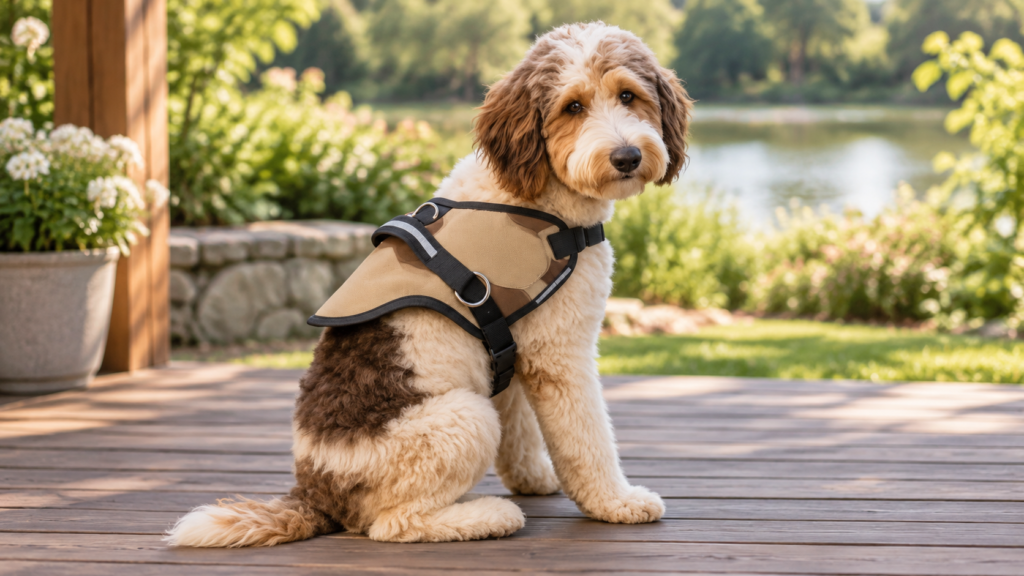
Key components to review
| Component | Recommended Design Consideration | Why It Matters |
|---|---|---|
| Metal D-Rings | Corrosion-resistant hardware with suitable strength ratings | Helps maintain secure leash connections |
| Side-Release Buckles | Durable acetal or other application-appropriate materials | Supports repeated opening and closing |
| Webbing Connections | Reinforced box-X stitching or bartack patterns | Helps secure high-stress attachment points |
| Adjustment Sliders | Stable grip on correctly matched webbing | Reduces unwanted strap loosening |
| Back Handles | Reinforced construction based on intended use | Improves handling without relying on decorative stitching |
Stronger hardware is not always the best choice if it adds unnecessary weight. The goal is to match the component to the application.
For bulk orders, buyers should request agreed test methods and acceptance criteria for the finished assembly, not just the individual buckle or D-ring.
These may include pull testing, repeated buckle operation, and inspection of high-stress stitching.
Our pet bag quality control process explains how Aimazing Bag approaches material checks, production inspections, and finished-product quality control.
For specialized mobility-related equipment, any load-supporting function should be separately assessed and validated. A standard leash attachment or handling loop should not automatically be treated as a body-weight support device.
4. Practical Accessories: Give Every Feature a Purpose
More pockets do not necessarily make a better product.
Some working-dog handlers need quick access to identification documents, small personal items, or supplies. Others prefer a lightweight vest with no additional storage.
For buyers planning a support dog vest custom project, it is worth deciding which accessories users will actually need before adding them to the design.
Useful customization options
Removable Identification Patches
Hook-and-loop panels allow brands to offer different labels or replace worn patches without changing the entire vest.
Small Zippered Pockets
Compact compartments can hold lightweight essentials. They should be positioned away from areas where they might interfere with movement.
Modular Attachment Points
Reinforced webbing loops can support optional accessories, provided the additional weight and attachment strength have been considered.
Balanced Layout
Placing all accessories on one side can make a vest feel uneven. Where storage is needed, keeping the design balanced is generally preferable.
There is also a cost consideration.
Every extra zipper, pocket, and attachment point adds materials and sewing operations. For a wholesale product line, that can affect pricing, sample development, and production consistency.
Our recommendation is to begin with a clean, functional base design and add optional features only when they offer a clear benefit.
Brands developing matching equipment can also explore our custom pet accessories manufacturing service for related products and coordinated collections.
5. Identification Design: Visibility Is Important, but So Is Accuracy
Clear identification is one of the main reasons brands develop a working dog identification vest.
A good label should be easy to read without requiring a complicated design. Poor contrast, small lettering, and low-quality printing can make identification difficult, especially after regular use.
However, there is an important distinction that brands selling into the US market should understand.
According to the US Department of Justice’s ADA guidance, service dogs are not legally required to wear identifying vests, patches, or special harnesses under the ADA.
The guidance also makes clear that emotional support animals are not automatically considered service animals. Service dogs must be individually trained to perform disability-related tasks.
This matters when developing a custom emotional support dog vest for the US market. A label should describe the product appropriately without suggesting that the vest itself grants service-animal status, certification, or public-access rights.
Design features worth considering
- Readable lettering: Use simple fonts and strong contrast between the text and background.
- Replaceable patches: Allow identification to be changed without replacing the product.
- Reflective details: Add reflective strips where better visibility in low-light conditions would be useful.
- Durable decoration: Select embroidery, printing, or heat-transfer methods according to the fabric and care instructions.
For example, black lettering on a bright yellow panel is often easier to distinguish than thin gray lettering on dark fabric.
Reflective tape may improve visibility when light reaches it, but its effectiveness depends on the material, placement, viewing angle, and lighting conditions.
For a professional working dog identification vest, the aim should be clear communication and reliable construction, not claims of official certification that the product cannot provide.
6. Guide Dog Harnesses Need a Different Design Approach
A guide dog’s working equipment has a different purpose from a standard walking vest.
In particular, a custom guide dog harness may need a structured handle that allows the handler to feel changes in the dog’s movement and maintain an appropriate working position.
This is not something that should be treated as a simple decorative accessory.
For example, Guide Dogs for the Blind describes a harness with a fairly rigid U-shaped handle and a quick-connect attachment system. The organization also offers different handle lengths and styles to suit individual handlers.
This is a useful real-world example of why handle fit matters.
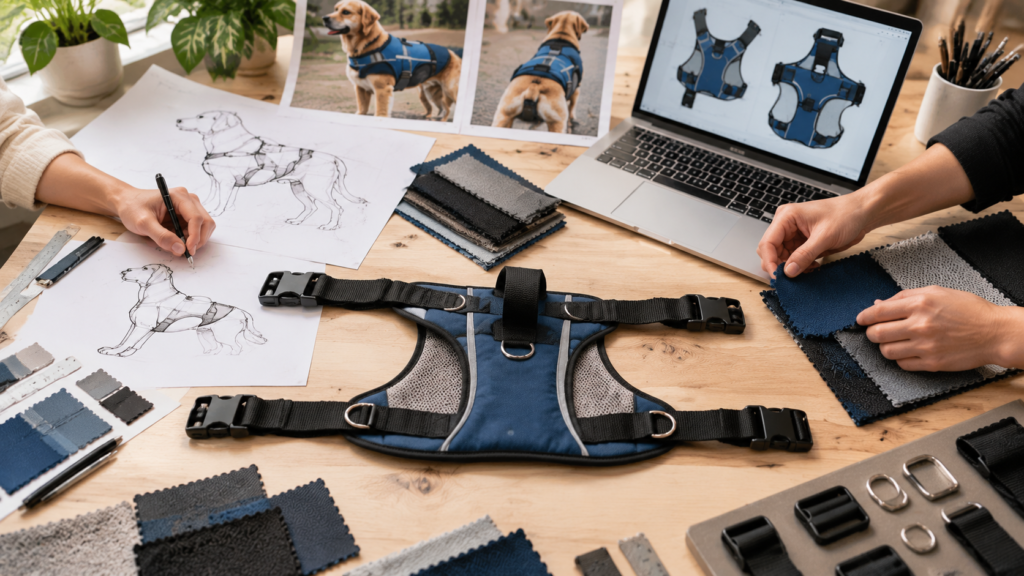
Four details buyers should discuss
Handle Length and Position
The handle should suit the handler’s height, arm position, and working relationship with the dog. One fixed handle size may not work for everyone.
Secure Attachment
The connection between the handle and harness body needs appropriate strength and should be checked for unwanted movement, loosening, or wear.
Weight and Comfort
Adding metal reinforcement may improve rigidity, but the complete assembly must remain suitable for the dog.
Removable Components
A detachable handle may make storage or everyday transitions more convenient, provided the connection remains reliable during use.
At Aimazing Bag, we believe that developing specialized working-dog equipment should involve feedback from the intended users and, where appropriate, qualified trainers or guide-dog organizations.
A custom guide dog harness should be evaluated for its intended navigation function. It should not be marketed as suitable for supporting a handler’s body weight unless that separate function has been specifically designed and tested.
7. From Product Idea to Bulk Order: What Buyers Should Confirm
Good product development involves more than choosing a material and sending a logo.
For a brand introducing a custom assistance dog vest, we recommend starting with the intended user, the dog’s size range, and the actual working environment.
At Aimazing Bag, our role as an OEM/ODM manufacturing partner is to help translate those requirements into a practical product design that can be produced consistently.
Our development approach
Step 1: Understand the Product Requirements
We review the target market, intended use, size specifications, materials, accessories, and expected pricing.
Where appropriate, we also ask about working loads and product testing requirements.
Step 2: Review the Design and Materials
Our team discusses suitable fabric options, structural details, logo methods, hardware, and production considerations.
We may suggest changes that improve comfort, reduce unnecessary complexity, or make production more consistent.
Step 3: Develop and Evaluate Samples
For suitable designs using available materials, our standard sampling target is 3–5 days after the specifications are confirmed.
Complex structural designs, newly developed components, and specialized guide handles may require additional development time.
Sample approval should include fit, construction, and functional checks rather than appearance alone.
Step 4: Confirm Production Specifications
Before bulk production, the approved sample should be supported by a clear specification covering materials, measurements, sewing details, colors, labels, and packaging.
Step 5: Manage Bulk Production and Quality Control
Aimazing Bag supports OEM/ODM projects with a starting MOQ of 100 pieces for eligible designs, subject to material and construction requirements.
We follow staged quality checks covering incoming materials, production workmanship, and finished goods.
You can learn more about our customization and production process.
For brands entering a specialized category, starting with a manageable order can also help gather feedback before expanding the range.
Final Thoughts: Build for Real Use, Not Just Product Photos
A professional vest needs to balance comfort, practicality, durability, and consistent manufacturing.
For buyers, the most important decisions often happen before the first sample is finished: Where will the straps sit? Which parts need reinforcement? Will the materials withstand normal cleaning? Can the factory reproduce the approved design across a bulk order?
These questions are worth discussing early.
At Aimazing Bag, we work with brands, wholesalers, and distributors to develop custom pet products, from material and structure selection to sampling and production.
If you are planning a custom assistance dog vest collection, share your product idea, intended use, and design requirements with our team. We can discuss how to turn your concept into a practical OEM/ODM project.
Looking for a manufacturing partner for your next pet product?
Contact Aimazing Bag to discuss your customization requirements.