French Bulldogs have a distinctive build that can make everyday walking gear harder to size than many buyers expect. Their compact bodies, powerful chests, and short necks create a specific fit challenge: a harness may look suitable on a size chart but still sit poorly once the dog starts moving.
For pet brands, wholesalers, and distributors, this is an opportunity to develop a product with a clearer purpose. Instead of competing with another generic small-dog style, a breed-focused design can address a recognizable fit problem and give a collection a stronger reason to stand out.
1. Why Can a Standard Harness Fit Poorly on French Bulldogs?
A generic small-dog harness is often graded mainly by weight or overall chest circumference. That approach can overlook the relationship between the chest, neck opening, shoulders, and front legs. A custom frenchie harness needs to account for these proportions rather than simply scaling down a pattern designed for another breed.
The French Bull Dog Club of America describes the breed as muscular and compact, with a thick, well-arched neck, a short body, and a broad, deep chest. The back is also broader at the shoulders and tapers toward the rear. These are not minor details: they affect where the harness sits, how the straps travel around the body, and how much adjustment is needed.
Reference: French Bull Dog Club of America – French Bulldog Breed Standard
For buyers, the key issue is proportion. If the chest area fits but the neck opening is too large, the harness may shift. If the neck is adjusted too tightly to stabilize it, the straps may create unwanted pressure. A pattern designed around a different body shape may also bring the girth strap too close to the front legs.
2. Which Measurements Should Buyers Prioritize?
A reliable french bulldog harness fit should be based on several measurements, not a single weight range. The most useful starting points are:
- Chest girth: Measure around the widest part of the ribcage, usually just behind the front legs.
- Neck circumference: Measure around the base of the neck where it meets the shoulders.
- Chest width and depth: Record the front profile so the chest panel can be proportioned correctly.
- Underarm clearance: Check the distance between the front legs and the intended strap path.
- Adjustment range: Confirm that each size can accommodate normal variation without relying on excessive strap length.
The American Kennel Club also identifies the base of the neck and the widest part of the chest as key harness measurements. It recommends checking the fit during movement and watching for rubbing or restricted shoulder and leg movement.
Reference: American Kennel Club – Choosing the Right Harness for Your Dog
This measurement logic is especially important when developing a small broad chest harness. The size chart should reflect the actual relationship between chest and neck measurements, rather than assuming that all small dogs share the same proportions.
3. How Should the Pattern Be Designed for a Short Neck and Broad Chest?
A personalized french bulldog harness should start with a breed-specific pattern, not a standard small-dog template with a different label. The front panel, neck opening, side straps, and girth strap need to work together as one structure.
1. Keep the throat area clear.
The front section should sit on the chest rather than ride high against the throat. This is a relevant design consideration for flat-faced breeds. The RSPCA advises walking brachycephalic dogs in a harness rather than attaching the lead to a collar, to avoid pressure on the neck.
A harness does not treat BOAS or replace veterinary advice, but thoughtful strap placement can avoid adding unnecessary pressure.
Reference: RSPCA – Caring for Dogs with Brachycephaly
2. Shape the chest panel around the dog’s build.
A broad chest needs sufficient coverage and a stable contact area, but extra width should not interfere with the front legs. Panel shape and strap angle matter as much as the material.
3. Allow natural shoulder movement.
The harness should remain clear of the armpits as the dog walks, turns, and sits. A panel that looks generous on a flat product photo may still rub when the dog moves.
4. Balance adjustment with pattern accuracy.
Adjustable straps help accommodate differences between individual dogs, but adjustment cannot correct a fundamentally unsuitable pattern. The base shape and size grading must be right first.
These priorities distinguish a thoughtfully developed brachycephalic dog harness from a generic style that only changes its color or size label. The goal is not to promise a medical benefit; it is to create a well-positioned walking product that can be assessed for fit, comfort, and movement.

4. How Can Brands Personalize the Product Beyond a Logo?
A custom frenchie harness can become a recognizable part of a brand’s walking collection when customization goes beyond surface decoration. Buyers can define the product around their target retail position and customer expectations.
Possible development options include:
- Materials: Polyester or nylon webbing, breathable mesh, soft lining, and selected padding, depending on the intended use and construction.
- Color and finish: Custom color combinations, contrast binding, reflective details, and coordinated hardware.
- Structure: Chest-panel dimensions, strap width, adjustment positions, buckle placement, and leash attachment options.
- Branding: Woven labels, rubber patches, embroidery, printing, or other suitable logo applications.
- Retail presentation: Size labels, hangtags, barcode labels, packaging, and matching leash or collar options.
For a personalized french bulldog harness, the most valuable customization decisions are those that support the fit concept and make the product easy for retailers to explain. A distinctive colorway is useful, but a clearly differentiated pattern and a practical size chart give the product a stronger reason to exist.
5. What Makes a Breed-Specific Design More Valuable to Pet Brands?
A generic harness competes in a crowded category where buyers may compare products mainly by price, appearance, and basic materials. A Frenchie-focused style gives brands a more specific product story: a personalized french bulldog harness is developed around a recognizable body shape rather than marketed to every small breed.
That positioning can support several B2B advantages:
- Clearer assortment planning: A dedicated style gives retailers a reason to add a breed-focused option instead of another general small-dog harness.
- More useful product information: Brands can explain which measurements matter and how the pattern is intended to sit.
- A more focused size range: Size grading can be planned around French Bulldog proportions instead of copying a broad small-dog chart.
- Stronger private-label identity: Materials, colors, branding, and packaging can be aligned with the rest of the brand’s walking range.
A small broad chest harness should not be treated as a miniature version of a large-breed product. Its dimensions, strap routes, and contact areas need to be developed for the intended body shape.
For a related example of breed-specific product development, see our Custom Dog Harness for Pitbulls: Fit, Strength and Market Positioning and Personalized Harness for Large Dogs.
6. What Should a Frenchie Harness Manufacturer Validate Before Bulk Production?
Before approving a production sample, brands should ask the supplier to demonstrate how the product performs on dogs with different measurements within the target size range. A single fitting session on one dog is not enough to confirm a complete size chart.
A Frenchie harness manufacturer should be prepared to review:
- Whether the chest panel stays in the intended position during walking and turning.
- Whether the neck opening remains secure without being over-tightened.
- Whether straps stay clear of the armpits and do not rub during movement.
- Whether the dog can reverse out of the harness.
- Whether buckles, adjusters, webbing, D-rings, and reinforced seams match the approved specification.
- Whether the same measurements and construction details can be repeated consistently in bulk production.
The AKC recommends checking that a harness does not restrict movement, testing whether a dog can slip out, and looking for rubbing or pressure points. These practical checks can be adapted into a brand’s sample approval checklist.
Testing should cover the complete product rather than only individual components. A strong metal ring cannot compensate for weak stitching, and a durable strap cannot solve a poor fit. Buyers should agree on the applicable test methods and acceptance criteria with their supplier before production.
7. What Can an OEM/ODM Partner Contribute Beyond Production?
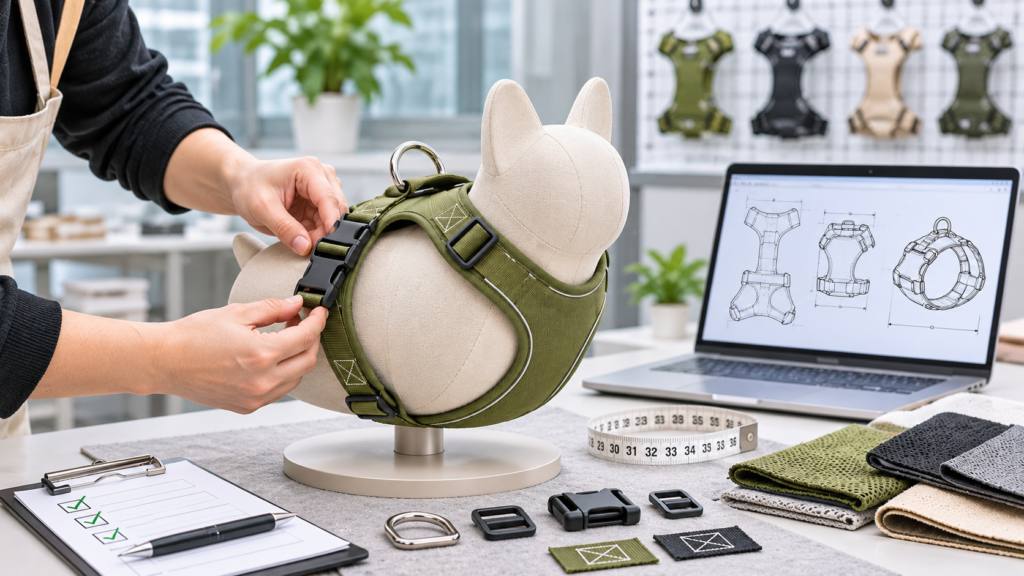
The difference between a basic supplier and a development partner is the ability to translate a product brief into a repeatable specification. For a breed-specific project, that means discussing measurements, pattern revisions, material choices, branding, and sample feedback before confirming the bulk order.
At Aimazing, our pet harness development service supports customization of materials, colors, sizes, structures, accessories, and branding. Our customization process covers requirement confirmation, design proposals, sampling, sample adjustments, production, and inspection.
Brands can also explore our custom pet harness collection for additional OEM/ODM development options.
With an MOQ starting from 100 pieces, more than 200 workers, and 10 production lines, Aimazing can support both emerging brands testing a focused product concept and established buyers planning repeat orders. Our sampling process is designed to turn confirmed specifications into physical samples for review before bulk production.
8. What Should Buyers Include in a Frenchie Harness RFQ?
A detailed RFQ helps the manufacturer quote accurately and reduces avoidable revisions. For this project, buyers should provide:
- Target dog measurements, including chest girth, neck circumference, chest width, and body weight range.
- Reference photos showing the intended fit from the front, side, and top.
- Preferred harness style and the required leash attachment positions.
- Target materials, lining, padding, webbing, hardware, and color references.
- Size range and expected quantities per size and color.
- Logo method, packaging requirements, barcode or SKU details, and target market.
- Required sample quantity, testing expectations, target price, and delivery schedule.
If the product is intended for a new private-label range, it is also useful to share the brand’s existing packaging and visual guidelines. This allows the supplier to consider the harness as part of a collection rather than as an isolated item.
9. Frequently Asked Questions
Is a standard small-dog harness suitable for every French Bulldog?
Not necessarily. Dogs within the same breed can still differ in chest girth, neck circumference, and body condition. For a consistent french bulldog harness fit, buyers should evaluate the actual measurements and fit instead of assuming that a general small-dog size will work for every dog.
Why does a brachycephalic dog harness need careful strap placement?
French Bulldogs are short-faced dogs, and welfare organizations advise using a harness rather than a collar for walking to avoid putting pressure on the neck. The harness still needs to fit correctly, remain clear of the throat, and allow natural movement. It should never be marketed as a treatment for breathing conditions.
What should buyers look for in a Frenchie harness manufacturer?
Look for a partner that can discuss breed-specific measurements, adjust patterns, make and revise samples, customize materials and branding, and maintain approved specifications during bulk production. A supplier should be able to explain how fit and construction will be checked—not simply offer a logo change.
10. Conclusion: Can Breed-Specific Fit Help Your Brand Stand Out?
The opportunity is not to put a French Bulldog graphic on a generic harness. It is to develop a product around the breed’s short, thick neck, broad chest, compact body, and movement requirements—and then validate that design through real fitting and sample review.
A personalized french bulldog harness gives brands a clearer way to serve a defined customer group while building a more differentiated walking collection. With breed-focused pattern development, flexible OEM/ODM customization, and a controlled sampling-to-production process, Aimazing can help turn that concept into a product ready for your target market.
Are you planning to add a Frenchie-focused harness to your next pet collection? Contact Aimazing to discuss your design brief, sample requirements, and bulk production plan.