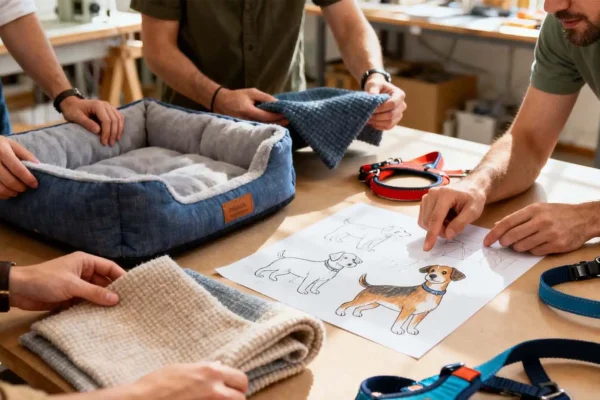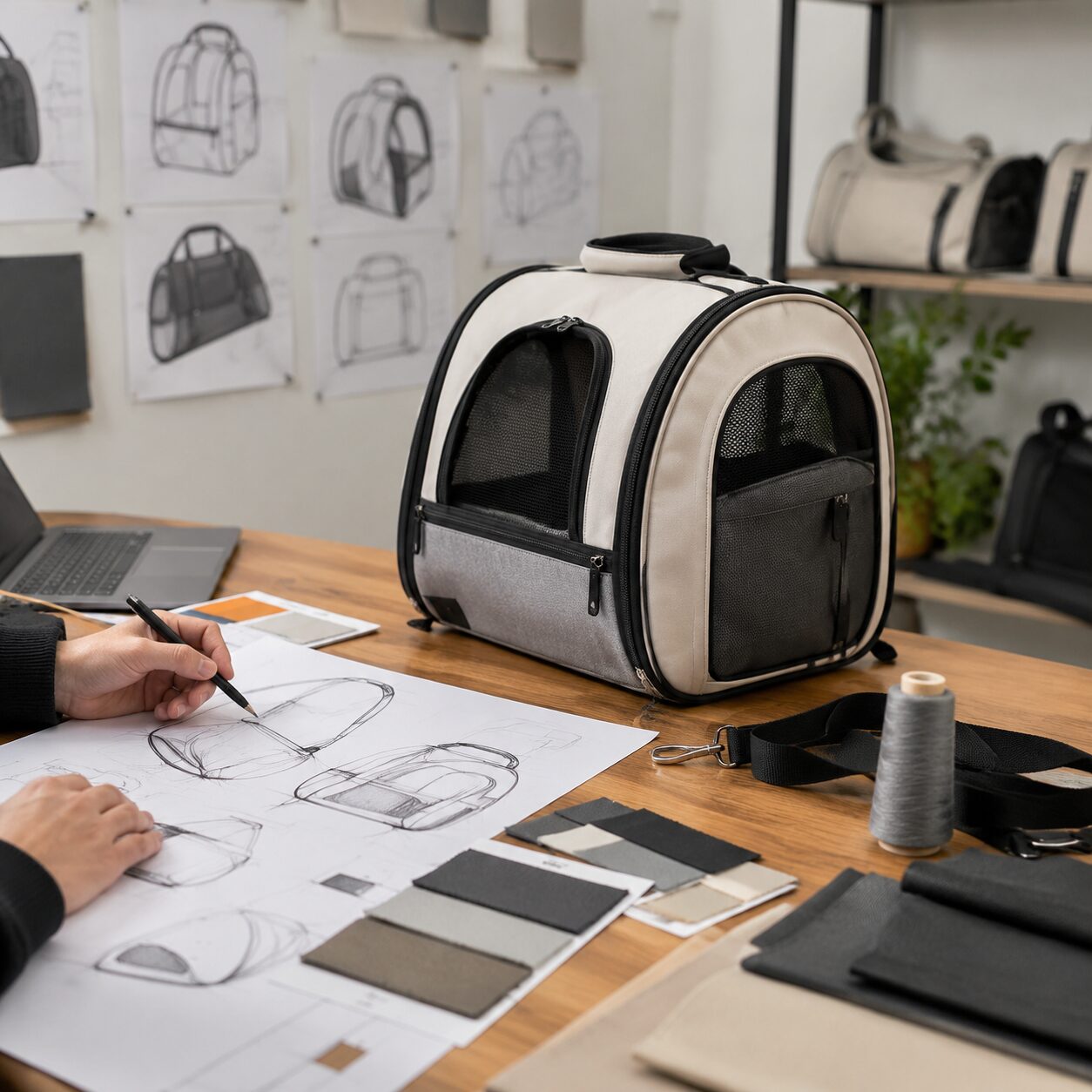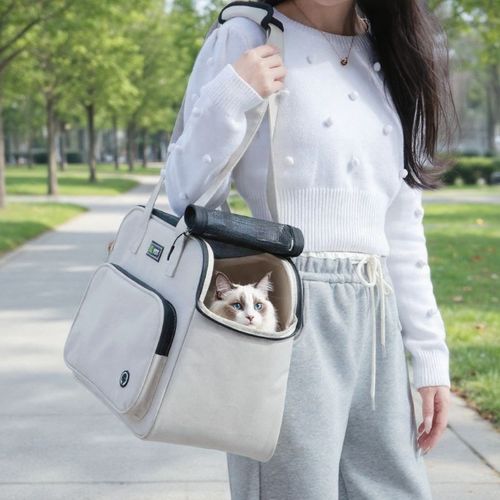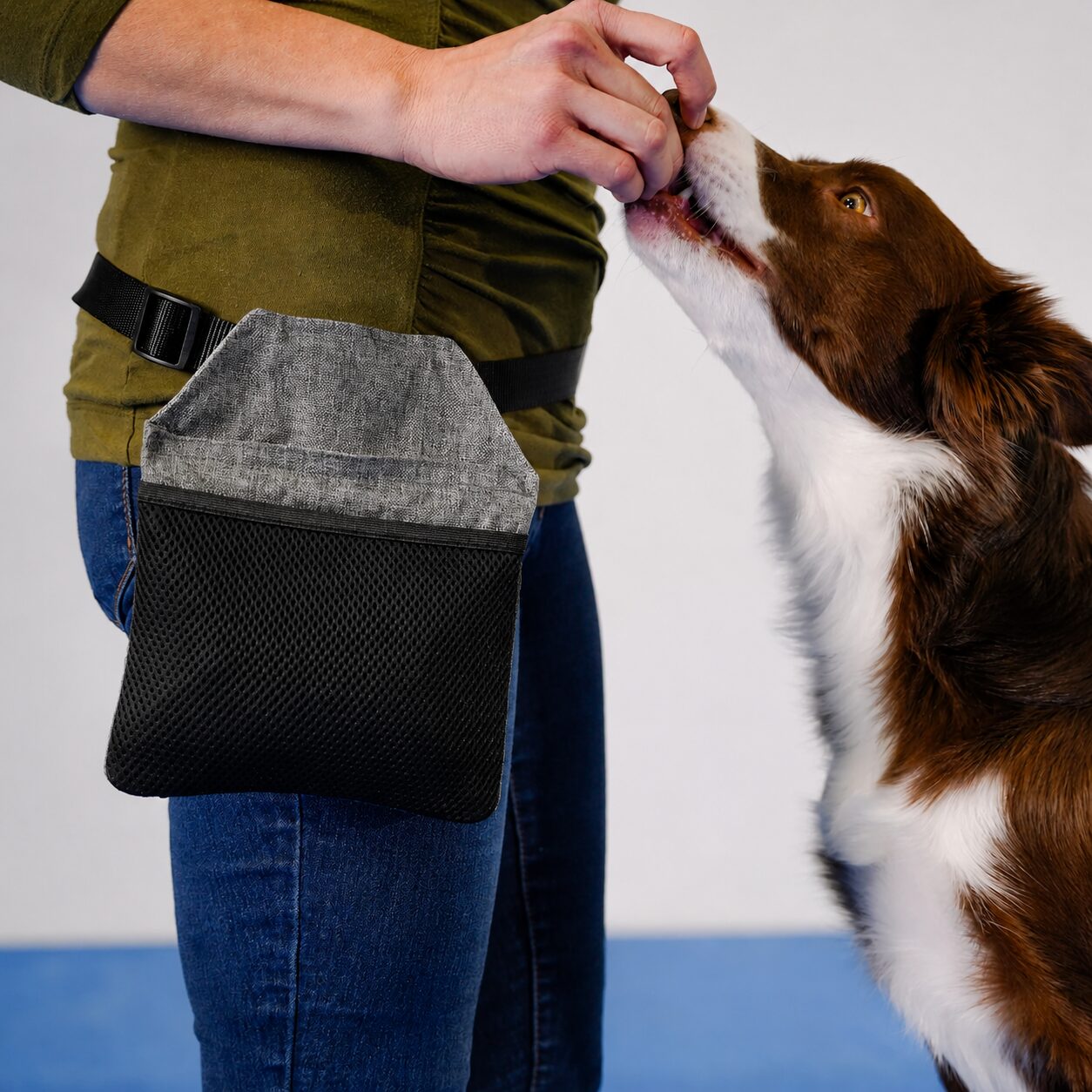
Two samples can look almost identical on a meeting-room table and behave very differently on a training field. One keeps its opening accessible while a handler rewards a dog; the other folds inward after a few minutes of use. One stays close to the waist during movement; the other swings forward with every step.
For pet brands, importers, distributors, and private-label buyers, that difference matters long before a product reaches a retail shelf. Attractive stitching and neatly placed logos are worth checking, but they cannot tell you whether a pouch will work reliably, remain easy to clean, or match the quality of a future production batch. This guide explains how to compare physical samples through practical tests, manufacturing evidence, and clearly documented approval criteria.
1. Establish a Fair Comparison Before You Handle the Samples
A capable dog training pouch supplier should be able to explain what a sample is intended to prove. Is it a visual mockup, a functional prototype, or a pre-production reference built with approved materials? These are different milestones, and treating them as interchangeable creates avoidable purchasing risk.
Start by giving each shortlisted factory the same brief: intended user, pouch dimensions, types of treats, wearing method, target market, expected order volume, logo application, and target price range. Ask that any deviations be identified instead of silently substituted. If one sample uses a premium buckle and another uses a basic clip, their prices and performance are not directly comparable.
Request a short sample record covering the material list, closure type, hardware specifications, dimensions, and any unfinished details. A transparent list of what is not yet finalized can be more valuable than a polished presentation.
2. Test One-Handed Access, Not Just the Shape of the Opening
The first job of a reward pouch is to help a handler deliver a treat without losing attention or fumbling with the bag. When comparing a pet training bag supplier, pay attention to the time and effort needed to reach inside while the pouch is actually being worn.
Try the following checks with dry treats and, if appropriate for the proposed lining, soft rewards:
- Wear the sample in the position intended for the retail customer, rather than holding it on a desk.
- Retrieve treats repeatedly with one hand while the other hand remains occupied.
- Check whether the rim collapses, catches the fingers, or forces the wearer to look down.
- Bend, walk, and turn to see whether the closure opens unintentionally.
- Repeat the exercise after partially emptying the pouch, when its shape may change.
Magnetic closures can be convenient, but their strength alone is not a measure of good design. Magnet placement, opening geometry, material thickness, and the way the fabric folds all influence access and retention. A drawstring may secure treats more positively in some settings but take longer to operate. Instead of asking which closure is “best,” ask which works for the buyer’s target audience.
3. Look Inside: Lining, Cleaning, and Material Documentation
A dog treat pouch factory should be willing to discuss the interior with as much care as the exterior. Crumbs collect around seam allowances; oils can mark absorbent surfaces; and narrow corners make wiping difficult. Those problems may not show up during a five-minute showroom inspection.
Inspect whether the lining lies smoothly, whether the corners can be reached for cleaning, and whether a removable insert would be more practical for the intended use. Compare stitching and bonded constructions where relevant, but do not assume either method is inherently leakproof. If the brand wants to advertise easy cleaning, the claim should match the final construction and the care instructions.
For products intended to hold unwrapped edible rewards, ask for material-specific documentation appropriate to the intended market and use. A label such as “food-grade” is not sufficient evidence by itself. The U.S. FDA’s guidance on assessing food-contact material components is a useful reference for buyers evaluating relevant U.S. requirements; other destinations may have different rules. Documentation needs to address the actual material formulation and conditions of use, not merely the generic name of a coating.
4. Check Stress Points That Product Photos Cannot Reveal
For a professional trainer pouch supplier, the functional sample should survive realistic repeated handling. Focus on belt loops, clip mounts, strap connections, dispenser openings, zipper ends, and the edges of reinforced panels. These are areas where small construction differences can affect daily usability.
Turn the pouch inside out where possible. Look for consistent seam allowances, secured thread ends, appropriate reinforcement, and any sharp or rough hardware backs. Gently load the pouch to the planned working weight and assess whether attachments twist or seams distort. If formal pull or fatigue testing is needed, agree on the test method, target load, cycle count, and acceptance criteria before commissioning it.
Do not accept “heavy-duty” or “premium stitching” as a substitute for a specification. A useful sample evaluation records what was inspected, how it was tested, and what the buyer observed.
5. Evaluate Stability With the Pouch Loaded and in Motion
An empty display sample often sits neatly against the body. A filled one may behave very differently. For a bulk dog training pouch program, movement checks can reveal design issues that would otherwise be multiplied across an entire order.
Use a realistic combination of treats and accessories, then walk briskly, crouch, change direction, and reach into the bag. Observe whether the pouch tilts, bounces, catches on clothing, or makes the wearer adjust the strap. Compare a belt clip with a waist strap where both are proposed, and ask whether each configuration can be produced consistently.
A dispenser hole is another detail that deserves a real-use check. It should allow waste bags to be pulled out without forcing the wearer to open the main treat compartment, and its placement should not weaken a highly stressed seam. Extra pockets should earn their space by making the product more useful—not merely by making the sample look feature-rich.

6. Ask Whether the Sample Can Be Repeated in Production
The question behind training bag OEM development is not simply whether one skilled sample maker can produce an attractive prototype. It is whether the factory can repeat the approved construction using specified materials, standardized sewing methods, and documented checks.
Before approval, request a bill of materials (BOM), measurement tolerances, hardware references, logo specifications, and photographs of critical construction details. Confirm how the factory manages unavailable trims or fabric lots. Substitutions should require buyer approval when they affect appearance, function, cost, or compliance.
At Aimazing, our OEM/ODM service process includes design development, prototyping, structural refinement, and quality checks from material selection through finished goods. For buyers, the useful deliverable is not just a finished sample but a clear production reference that different operators and inspectors can understand.
7. A Documented Buyer Experience: Why Revision Support Matters
Real customer feedback offers one way to assess how a manufacturing relationship works after the first sample or design discussion. On Aimazing’s pet manufacturing website, a customer identified as Jn from Australia commented on a pet bag order: “They fixed my design tweaks quickly and kept me posted the whole time.”
This is a published customer testimonial, not a separately audited case study. The public account does not identify the exact bag model, order quantity, changes requested, or measurable test outcomes. Its value is more specific: the buyer reported that design adjustments were addressed and progress was communicated during the project.
Those are practical points for a B2B sourcing team to verify. If a sample needs a wider opening or a repositioned clip, does the factory explain the trade-off, document the revision, and show the change before production approval? A dog treat pouch factory that can handle that conversation clearly is offering more than basic order taking.
Our approach is to act as a development partner rather than only quote an existing shape. Buyers can learn more about our team and manufacturing background on the Aimazing About Us page. For a product-specific reference, they should still request actual sample photographs, change records, and inspection evidence relevant to their own design.
8. Score the Samples With a Buyer-Defined Comparison Matrix
When choosing a dog training pouch supplier, a written scorecard makes decisions easier to explain across sourcing, product development, sales, and quality teams. The table below is a suggested purchasing tool, not an industry-certified grading system. Adapt the weights and pass/fail requirements to the intended product.
| Evaluation area | Suggested weight | Evidence to record |
|---|---|---|
| One-handed access and closure | 20% | Repeated access observations while worn |
| Fit, movement, and attachment stability | 20% | Loaded walking and bending assessment |
| Lining and cleanability | 15% | Interior inspection, cleaning trial, documentation |
| Seams, hardware, and construction | 15% | Stress-point inspection and agreed functional checks |
| Production repeatability | 15% | BOM, tolerances, approved component references |
| Communication and revision control | 10% | Change log, responses, sample updates |
| Appearance and branding accuracy | 5% | Logo, color, size, workmanship comparison |
| Total | 100% | Buyer approval record |
Score each category consistently—for example, on a 1-to-5 scale—and calculate a weighted result. Keep mandatory requirements separate: a sample with unacceptable attachment security or missing required material evidence should not pass just because it scores well on appearance.
Include photographs and short comments beside the scores. A sourcing decision supported by observations is more defensible than one based on memory after a video call.
9. Compare Quotes Only After You Normalize the Specifications
A lower unit price may reflect a different fabric, less reinforcement, simpler packaging, or a cheaper attachment system. Before comparing quotations from a pet training bag supplier, ask each company to price the same approved specification and list any exceptions.
Review sample charges, tooling or logo setup, packaging, quantity breaks, lead times, shipping terms, and the handling of revisions. A low initial quote is not necessarily the lowest landed cost once these differences are included.
Aimazing lists a standard MOQ of 100 units per style/color for custom-branded pet bags and a typical sample lead time of 3–5 business days for applicable designs on its buyer FAQ page. Actual timing and cost depend on customization and material availability, so project-specific confirmation is still essential.
10. Judge the Factory’s Ability to Solve Problems Before Scale-Up
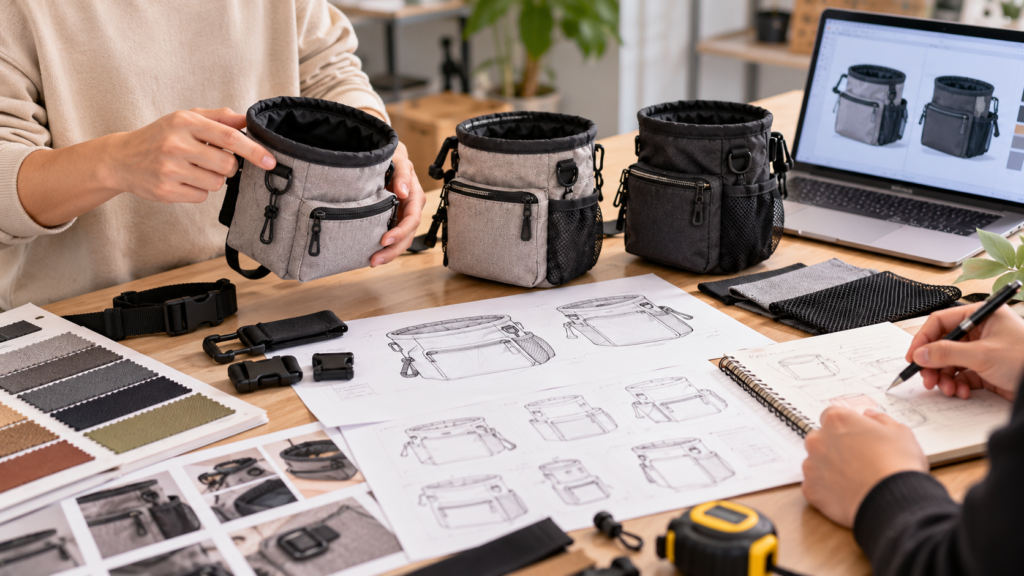
A good professional trainer pouch supplier should be comfortable discussing weaknesses identified during sampling. The best response is not always to add more material or more pockets. Sometimes the better answer is to move a fastening point, reduce pouch depth, change a corner construction, or simplify a feature that complicates cleaning.
In training bag OEM projects, that problem-solving ability is particularly valuable when a brand serves several user groups. Casual dog walkers may prefer compact, lightweight designs; active trainers may prioritize fast access and secure fit. One pouch does not have to serve every market, and a factory should be able to explain the costs of building multiple versions.
Ask the supplier to present at least two viable construction options when a feature is causing problems. Each option should state the expected usability trade-off, material change, sample implications, and effect on the final quotation. That is a more useful form of collaboration than promising every feature at any cost.
11. Turn the Approved Sample Into a Bulk Quality Standard
The approved prototype is only useful if it becomes a reference for incoming material checks, sewing, assembly, and final inspection. For a bulk dog training pouch order, agree on what qualifies as a critical, major, or minor defect, which dimensions are measured, how closures and attachments are checked, and what evidence will be shared before shipment.
For attribute-based lot inspection, buyers may refer to ISO 2859-1:2026, which describes AQL-indexed sampling procedures. It does not guarantee that every unit in an accepted lot is defect-free. Sample approval, in-process controls, and final inspection serve different purposes and should work together.
Keep an approved golden sample and a controlled specification sheet. Record version numbers whenever the lining, magnet, clip, logo placement, or packaging changes. Without version control, even a well-made initial sample can become an unreliable production reference.
12. Questions Worth Sending Before You Approve a Prototype
A short, well-structured email can reveal whether a potential factory understands the product. Before placing an order, ask:
- Is this sample made with the same materials and components proposed for mass production?
- Can you provide a BOM, measurement tolerances, and the proposed closure and attachment specifications?
- Which parts are likely to change after sampling, and how will those changes be approved?
- What practical use tests do you recommend for our target customers?
- Which documents can support our intended claims about materials and cleaning?
- Can you provide revision photos and a record of changes between sample versions?
- How will you check that the bulk order matches the approved reference?
- Which cost or delivery assumptions depend on order volume or material availability?
These questions are especially useful when comparing a newer private-label program with an established line. They help buyers identify what has been proven and what still needs development.
Frequently Asked Questions
How can I compare a dog training pouch supplier when the samples look equally good?
Give both samples identical loaded-use tests and review their BOMs, closure behavior, attachment stability, interior cleaning, revision records, and production controls. Document any differences before comparing unit prices.
Should a treat pouch sample be tested by a professional dog trainer?
For products positioned for regular training, hands-on feedback from intended users is highly useful. Choose tasks that match actual behavior—one-handed reward access, movement, repeated use, and access to other equipment—rather than treating casual visual feedback as product validation.
Is a magnetic opening always better than a drawstring?
No. Magnetic access can be quick, while a drawstring may provide more deliberate closure. The decision depends on the type of treats, expected movement, intended buyer, and tested pouch geometry.
Do I need to approve a new sample after a material change?
If the change affects function, feel, appearance, safety, compliance, or construction, review the affected parts and decide whether a revised physical sample is required. Record the decision in the specification rather than relying on an informal message.
Conclusion: Buy the Evidence, Not Just the Appearance
A convincing sample is a starting point—not proof that every manufacturing decision has been resolved. The strongest sourcing process tests the pouch in use, checks the materials and construction, documents changes, and connects sample approval to production controls.
When you are ready to develop a custom pet training pouch, work with a dog training pouch supplier that can discuss both product performance and manufacturing repeatability. At Aimazing, we support brands with OEM/ODM development, sampling, customization, and production planning. Share your project requirements to discuss a sample built around your customer, target price, and expected order program.