Buying a treat pouch for your pet product line may seem like a simple sourcing task. Most products look similar in photos: a small bag, a belt clip, a few pockets, and a place to store rewards.
The differences become clearer when someone actually uses them. Some pouches are difficult to open with one hand. Others spill treats when the wearer bends down. A bag might look great on a product page but become frustrating to clean after a week of training.
For pet brands, wholesalers, and distributors, these details matter. They affect customer reviews, product returns, and whether buyers come back for another purchase.
This guide walks through the main things worth checking before you approve a sample or place a bulk order. It also explains which features are worth customizing and where you can save money without making the product less useful.
1. Know Who Will Use the Bag Before Choosing a Manufacturer
Before asking for a quotation, think about who will buy the finished product.
A professional dog trainer may need quick access to rewards dozens of times during a session. Someone walking a dog around the neighborhood might care more about a phone pocket and waste bag dispenser. An outdoor enthusiast may prioritize durability and a secure closing system.
These customers don’t necessarily need the same product.
A good dog treat bag manufacturer should help you turn these different needs into a practical design rather than simply asking you to choose a color from a catalog.
For example, consider three common product directions:
| Target Customer | Main Priorities | Suitable Features |
|---|---|---|
| Everyday dog owners | Convenience and affordable pricing | Compact size, drawstring opening, waste bag dispenser |
| Professional trainers | Fast access and organization | Wide opening, one-hand operation, clicker holder, washable lining |
| Outdoor dog owners | Durability and secure storage | Reinforced fabric, weather-resistant exterior, adjustable carrying system |
For a new retail collection, you don’t need to develop all three.
Start with the customer group most likely to buy from your brand. Once that product is selling consistently, you can expand into other styles.
Buyer checklist:
- Who is the main customer?
- Where will the pouch be used?
- What is the target retail price?
- Which two or three features matter most?
- Will the product be sold alone or as part of a pet accessory collection?
These answers make the next sourcing steps much easier.
2. Check the Opening Design: Can Customers Reach Treats Easily?
One of the most common design mistakes is choosing a closure based only on appearance.
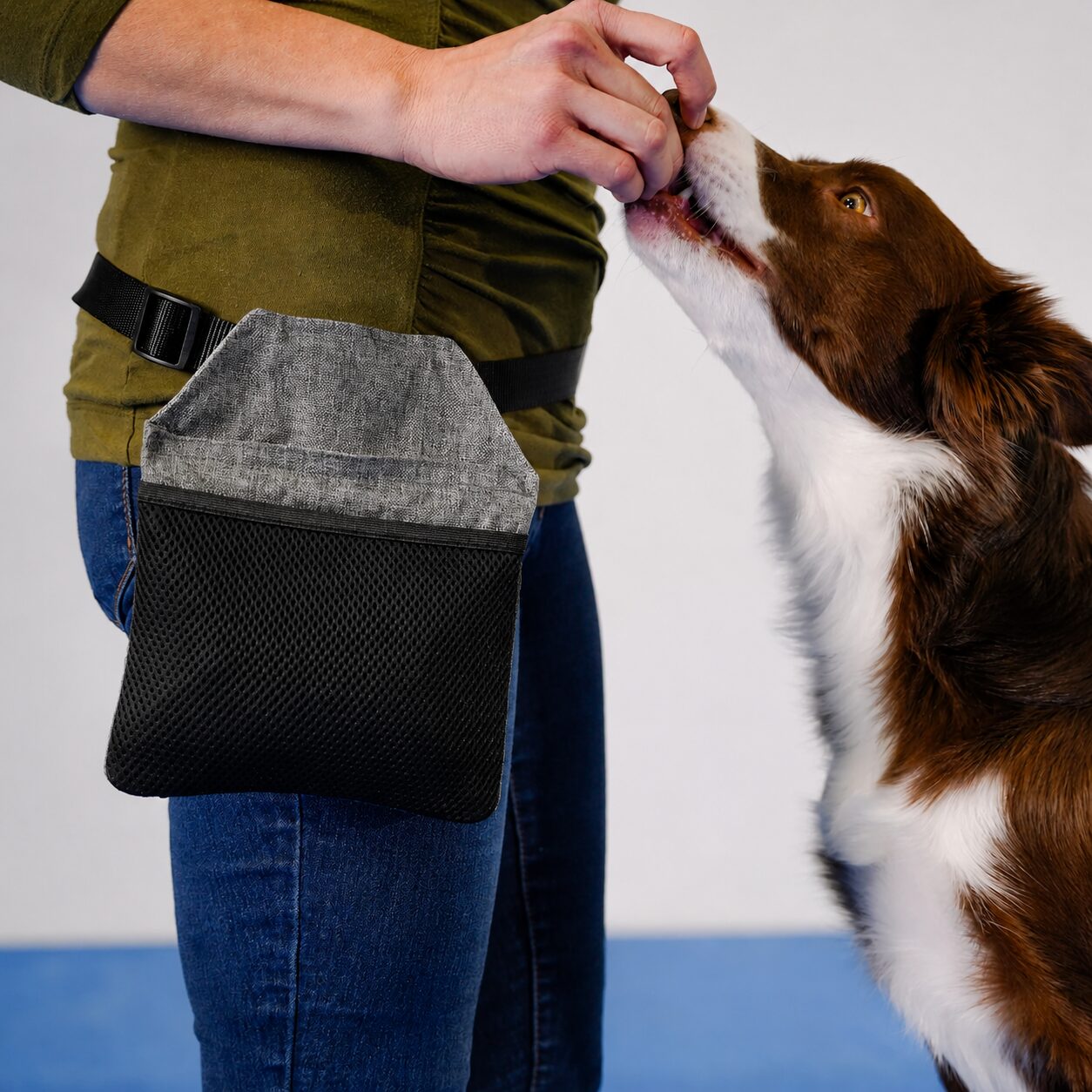
Imagine a trainer holding a leash in one hand while rewarding a dog with the other. If the pouch requires two hands to open, the design may interrupt the training session.
The opening needs to be convenient, but it should also keep treats from falling out when the user walks, runs, or bends down.
Different closures solve this problem in different ways.
| Closure Type | Advantages | Things to Consider |
|---|---|---|
| Drawstring | Simple, affordable, adjustable opening | May take longer to close securely |
| Magnetic | Quick access, convenient for one-hand use | Magnet strength and opening structure need testing |
| Spring-frame opening | Holds its shape and can provide fast access | Adds structure and may affect weight and cost |
| Zipper | Good for secure storage | Usually slower for repeated reward access |
There isn’t one closure that works best for every product.
For a professional training pouch, a wide opening with a suitable magnetic or spring-frame structure may make sense. For a budget-friendly walking pouch, a simple drawstring might be enough.
An experienced dog training bag manufacturer should be able to explain these differences and help buyers test the options before production.
At Aimazing, buyers can customize opening structures, internal layouts, and carrying methods rather than relying on a single fixed design.
Our Hands-Free Dog Training Reward Pouch is one example of a compact design with a wide opening, drawstring closure, and flexible belt attachment.
When reviewing a sample, put actual treats inside and try opening the bag repeatedly with one hand. Then close it and bend down, walk quickly, and shake it gently.
These simple checks often reveal more than product photos.
3. Choose Materials That Are Durable and Easy to Clean
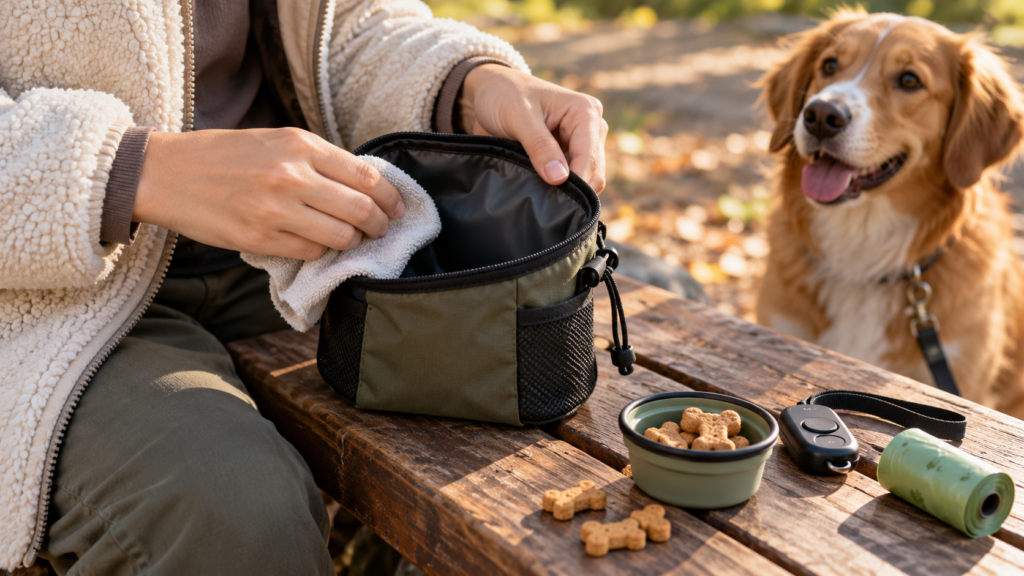
Treat pouches have a different cleaning problem from ordinary handbags.
Small pieces of food collect in corners. Moisture and oil can leave residue inside the compartment. If cleaning is difficult, customers may stop using the product even when the outer fabric is still in good condition.
That’s why the lining deserves as much attention as the exterior.
A dog treat pouch supplier should be able to explain the material choices and provide actual samples for comparison.
Here are some common options.
| Material | Where It Works Well | Buyer Considerations |
|---|---|---|
| 600D Polyester | Affordable everyday pouches | Durable, structured, widely available |
| Nylon | Lightweight training pouches | Flexible and suitable for active use |
| Ripstop Fabric | Outdoor training products | Lightweight with improved resistance to tear spreading |
| TPU-Coated Fabric | Moisture-prone areas | Water-resistant surface, usually easy to wipe |
| PEVA Lining | Treat storage compartments | Smooth surface that can make cleaning easier |
| Recycled Polyester | Sustainability-focused collections | Material traceability and certification should be checked |
For example, you might select a 600D polyester exterior with a wipe-clean lining for a practical mid-range product.
A more premium version could use lightweight nylon, a separate treat compartment, and a removable liner.
One detail buyers often overlook is whether the lining can actually be removed.
A smooth lining might be easy to wipe, but food crumbs can still become trapped in sewn corners. A removable insert may be easier to clean thoroughly, although it adds another component and potentially more cost.
It’s worth checking how the finished bag should be cleaned. Unless the whole product has been designed and tested for machine washing, don’t advertise it as machine washable.
If treats come into direct contact with the lining, request supporting documentation for the relevant material and destination market rather than assuming that every coated fabric is suitable for food contact.
The goal isn’t to choose the most expensive fabric. It’s to select a material combination that makes sense for the intended use and retail price.
4. Look Beyond the Main Pocket: Which Features Are Actually Useful?
Adding more pockets doesn’t automatically make a better product.
A pouch with six compartments might sound impressive, but customers may prefer three well-positioned pockets that they can access without looking.
Think about how the bag will be worn and what the user needs to carry.
Features worth considering include:
- Waste bag dispenser: Allows quick access to disposable bags without opening the main compartment.
- Clicker holder: Keeps a training clicker within easy reach.
- Phone pocket: Useful for everyday walking and outdoor activities.
- Adjustable waist belt: Supports hands-free use and different body sizes.
- Removable shoulder strap: Allows the pouch to be worn across the body.
- Reflective details: Improve visibility in suitable lighting conditions during evening walks.
- Separate toy pocket: Keeps toys away from food rewards.
Buyers should also consider the weight and balance of the finished bag.
For example, adding a large phone pocket to one side may make a lightweight pouch hang unevenly. A wider waist belt or different pocket placement could improve comfort.
This is something that should be checked with a physical sample, not only a drawing.
You can explore different structures in our Custom Pet Training Bag collection, including reward pouches, waist packs, shoulder bags, and multi-pocket training organizers.
5. Compare Customization Options, Not Just Catalog Prices
Two factories may quote similar prices for the same-looking bag, but their development services can be very different.
Some suppliers mainly offer existing designs with a logo added. Others can modify the materials, structure, compartments, and carrying system.
Neither approach is automatically better. It depends on your project.
For a small launch, an existing design with a custom label may be the most sensible choice. For a brand that wants a unique retail product, more development work may be worthwhile.
When developing an OEM dog treat bag, it’s helpful to compare three sourcing approaches.
| Development Option | What Can Be Changed | Best For |
|---|---|---|
| Existing design | Logo, available colors, packaging | Fast market testing and promotional products |
| Modified existing design | Fabric, lining, pockets, straps, selected hardware | Private-label brands wanting differentiation without starting from zero |
| New custom design | Dimensions, structure, opening, materials, accessories, branding | Brands building a distinctive product line |
A custom training pouch factory should be able to explain the likely cost and production impact of each modification.
For example, changing a woven logo to embroidery may be straightforward. Adding a new removable lining could require pattern adjustments and additional sewing operations.
A completely new magnetic opening may require extra sampling and hardware testing.
At Aimazing, we work with buyers through these decisions rather than treating every change as an isolated request.
Our OEM/ODM service includes material selection, structural adjustments, logo development, sample making, and production planning. You can learn more about our pet bag customization process.
The practical advantage is flexibility: a brand can start with an existing product, improve selected features, or develop a new structure according to its budget and market position.
6. Ask for a Quotation That Clearly Defines What Is Included
A low unit price isn’t necessarily a good deal.
One quote might include a basic polyester shell, standard zipper, and simple packaging. Another may include coated fabric, reinforced attachment points, customized hardware, and printed retail packaging.
Without a clear specification, comparing the two prices doesn’t tell you much.
Before ordering a bulk dog treat pouch, ask for a quotation based on the same product details.
Your RFQ (request for quotation) should include:
- Product dimensions and estimated capacity
- Exterior fabric type and specification
- Lining material and cleaning requirements
- Closure system and hardware
- Pocket layout and carrying method
- Logo technique, size, and placement
- Order quantity and color breakdown
- Packaging and labeling requirements
- Delivery destination and requested trade terms
Also ask whether logo tooling, custom hardware, packaging artwork, and sampling charges are included.
When comparing prices, ask each dog treat pouch supplier to quote the same specifications and quantities. This makes cost differences easier to understand.
How MOQ Affects Your Purchasing Decision
At Aimazing, our standard minimum order quantity for custom pet bags starts from 100 pieces per style/color, subject to the project’s material and customization requirements.
This can be useful for brands that want to test a product before committing to larger quantities.
However, MOQ alone doesn’t determine whether an order is cost-effective.
Small orders may carry higher unit costs because fabric cutting, machine setup, and logo preparation still take time. As quantities increase, some of these costs can be spread across more pieces.
If you’re considering 100, 500, and 1,000 pieces, request prices at all three quantities.
You may find that ordering slightly more makes sense. Or you may decide that a smaller first order is worth the extra unit cost because it reduces inventory risk.
Both are reasonable business decisions.
7. Request Samples and Test Them Before Bulk Production
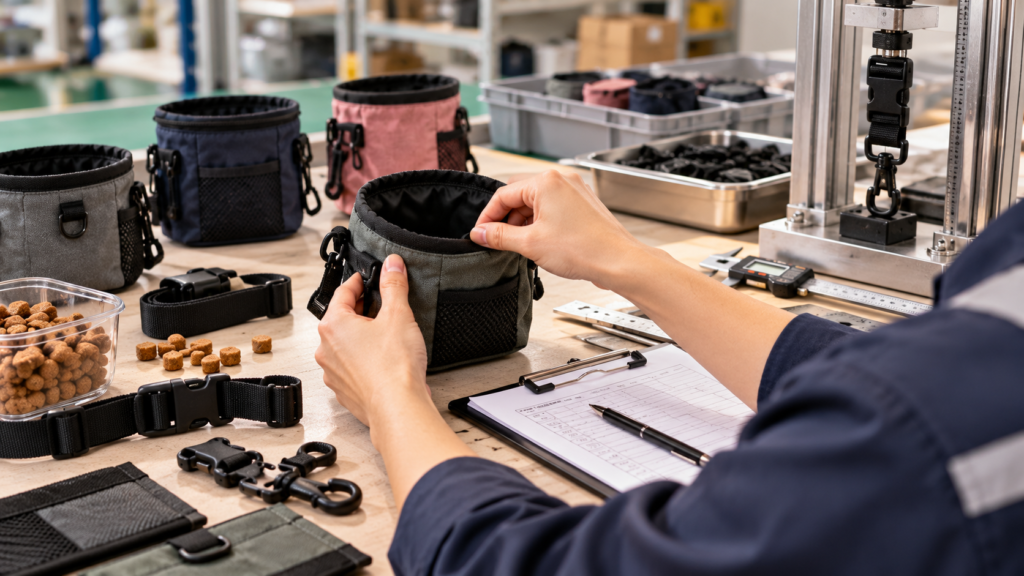
A sample shouldn’t be approved just because it looks like the reference image.
It needs to work as intended.
At Aimazing, standard samples can typically be prepared in 3–5 working days, depending on material availability and design complexity. More complicated custom structures or special components may require additional time.
When the sample arrives, don’t stop at checking the dimensions and logo.
Ask your dog training bag manufacturer how the finished design will be checked during production and which parts require extra attention.
Here are five practical tests worth including in your approval process.
Test 1: One-Hand Access
Fill the compartment with the type of treats your customers are likely to use.
Try opening and closing it repeatedly with one hand. Check whether the opening collapses, catches the user’s fingers, or slows down access.
Test 2: Spill Resistance
Secure the closure and move the pouch through normal walking, bending, and light running motions.
Does the opening stay closed? Do treats escape around the edges?
This test is particularly important for products designed for active training.
Test 3: Cleaning
Put a small amount of treat crumbs inside.
Try cleaning the lining according to the proposed care instructions. Check whether residue becomes trapped around seams or corners.
Test 4: Strap and Attachment Strength
Wear the pouch with its intended contents.
Check whether belt clips slip, adjustable buckles loosen, or attachment points pull away from the body.
Test 5: Pocket and Logo Placement
Put a phone, clicker, and waste bag roll into the planned compartments.
Make sure each pocket is accessible and that the logo remains visible when the pouch is worn.
After approving these details, ask the factory to preserve the agreed specifications in the pre-production sample and production documents.
At Aimazing, quality control covers material inspection, checks during sewing, finished-product inspection, and packing verification.
Learn more about our Quality Control process.
8. Buyer Scenario: Developing Two Treat Pouches Instead of One Generic Model
The following is an illustrative sourcing scenario showing how a private-label project could be developed. It is not presented as a verified customer order.
Consider a UK pet accessory brand preparing to launch a new dog walking collection.
The brand plans to purchase 500 units and initially requests a standard black treat pouch with a logo.
Its target customers include everyday dog owners and people who attend obedience classes.
The first idea is straightforward: one model, one material, one color, and one price point.
But there is a problem.
Everyday dog walkers may want an affordable pouch with storage for personal items, while training enthusiasts may be willing to pay more for faster access and a better cleaning system.
Instead of immediately manufacturing 500 identical units, the brand compares three development directions.
| Everyday Walking | Training-Focused | Outdoor Premium | |
|---|---|---|---|
| Outer fabric | 600D polyester | Lightweight nylon | Coated ripstop fabric |
| Main opening | Drawstring | Wide magnetic opening | Secure drawstring |
| Lining | Wipe-clean fixed lining | Removable easy-clean liner | Moisture-resistant lining |
| Carrying | Waist belt | Waist/crossbody | Wider adjustable belt |
| Extras | Waste bag dispenser | Clicker holder, phone pocket | Reflective trim, reinforced attachments |
| Positioning | Value | Mid-range | Premium |
After reviewing the options, the example brand chooses to test two products:
300 everyday walking pouches: A practical polyester model with a drawstring opening, waste bag dispenser, and woven logo.
200 training-focused pouches: A nylon model with a wide opening, removable lining, adjustable carrying options, and additional storage.
Both quantities are above the standard 100-piece starting MOQ.
This gives the brand two clear price points without developing three separate products at once.
What Makes This Approach Different?
A catalog-only purchasing approach might have led the brand to order 500 identical bags with its logo.
A development-focused approach allows the buyer to compare materials, closures, and features before committing to a final specification.
For this type of project, the role of the dog treat bag manufacturer goes beyond sewing and packing. The factory helps turn customer needs into practical product options.
The resulting OEM dog treat bag designs can share certain materials or hardware where appropriate, while still offering different features for different users.
For the buyer, the benefit is not simply having more options. It’s being able to make better decisions about cost, product positioning, and future range expansion.
9. Check Production and Packaging Before Issuing a Purchase Order
Once the sample is approved, there are still several details to confirm.
One of the most important is whether the bulk production will match the approved sample.
For example, a change in webbing width, buckle supplier, lining thickness, or sewing method can affect the final product even when the overall appearance remains similar.
Put the approved details in writing.
Final B2B Sourcing Checklist
- Final dimensions and tolerances confirmed
- Fabric and lining specifications approved
- Closure and hardware samples checked
- Logo size, color, and position approved
- Strap length and attachment methods confirmed
- Packaging and labeling requirements agreed
- Sample approval recorded
- Production lead time confirmed
- Quality inspection criteria agreed
- Shipping terms and final delivery destination confirmed
For a bulk dog treat pouch order, also confirm how products will be packed inside the master cartons.
If you’re selling through Amazon or another online marketplace, carton dimensions, unit packaging, barcodes, and labeling requirements may affect fulfillment costs.
Retail stores may have different needs, such as hangtags, display cards, or individual retail boxes.
These details are easier to settle before production than after the finished goods have been packed.
10. Frequently Asked Questions
Can I Order 100 Custom Treat Pouches for My Brand?
Yes. Aimazing supports OEM/ODM pet bag orders starting from 100 pieces per style/color under standard conditions.
You can customize an existing design with your logo, available materials, and selected features. More complex changes, special fabrics, or custom hardware may affect the minimum quantity and price.
For a new brand, starting with a proven structure and making a few useful changes is often a practical way to test demand.
What Should I Send to a Custom Training Pouch Factory?
Start with product reference pictures, target dimensions, estimated order quantity, and your logo.
It also helps to explain who the product is for, how you want it to be used, and your approximate target price.
You don’t need a complete technical drawing to start a discussion. A clear description of what you want the finished product to do can be enough for an initial proposal.
Can Treat Pouches Be Made with Removable Linings?
Yes. Depending on the structure, removable or wipe-clean liners can be developed for treat storage compartments.
However, the final design should consider how the liner is attached, how easily it can be removed, and whether it changes the opening size or available storage space.
Always test the cleaning method before making care claims on the packaging.
Is It Better to Customize an Existing Design or Develop a New One?
For first-time buyers, modifying an existing design often reduces development work and makes it easier to control costs.
Developing a new design may be more suitable when your brand needs a specific structure, unique carrying system, or distinctive functional feature that isn’t available in current products.
A good development partner should explain the advantages and limitations of both options.
How Can I Reduce Quality Problems in Repeat Orders?
Keep an approved reference sample and clear written specifications.
Check that fabric, lining, hardware, stitching, and logo details remain consistent. Agree on inspection requirements before production starts, and review any proposed material substitutions rather than accepting them automatically.
Consistent specifications make repeat ordering more predictable.
Conclusion: Choose a Manufacturing Partner That Understands Your Product
Choosing the right dog treat bag manufacturer involves more than comparing unit prices.
You need a partner who understands how the product will be used, what your customers are willing to pay, and which design details matter most.
Some brands need a simple walking pouch with a custom logo. Others want a training-focused design with quick-access storage, washable compartments, and multiple carrying options.
At Aimazing, we support both approaches.
With OEM/ODM manufacturing experience dating back to 2000, we help international pet brands, wholesalers, and distributors move from product ideas to samples and bulk production.
Our capabilities include:
- Custom materials, colors, structures, and logo options
- Product development and functional design support
- MOQ starting from 100 pieces
- Standard sampling in 3–5 working days
- Quality control throughout production
- Customized packaging and international shipping support
Planning a new pet training product?
Share your reference pictures, required features, target quantity, and budget with our team. We can help you compare practical options before you commit to production.