Two dogs can have almost the same chest measurement and still need a different harness fit. One may have a deep, narrow chest, while the other has a broader body and shorter legs. Put them in the same design, and one might fit comfortably while the other experiences rubbing or loose straps.
For pet brands, these differences matter. Poor fit can lead to customer complaints, product returns, and negative reviews. And once hundreds of harnesses have been manufactured, fixing a sizing problem becomes expensive.
So how can brands develop a size range that works for different dogs without making production unnecessarily complicated? It starts with accurate measurements, practical size charts, and testing samples on real dogs before bulk production.
1. Why Dog Body Shape Matters More Than Size Labels
When developing a custom size dog harness, the first mistake to avoid is assuming that dogs of similar weight have similar body shapes.
Consider a French Bulldog and a Beagle. They may weigh roughly the same, but their chest width, neck shape, and body proportions can be quite different.
A harness designed mainly around body weight may fit one dog well but sit too close to the front legs or leave too much space around another dog’s chest.
From a manufacturer’s perspective, we recommend checking three things before finalizing a design.
Chest shape: A deep-chested dog may need a different chest panel length from a broad, compact breed.
Strap position: Chest straps and padded edges should sit away from areas where they could rub during walking.
Adjustment range: The harness needs enough flexibility to accommodate normal body differences, without leaving excessive loose webbing.
Brands should also consider the intended activity. A lightweight walking harness and a heavy-duty training harness may need different materials, reinforcement, and fit requirements.
This is why a made to measure dog harness approach can be useful during early development, even when the final product will be manufactured in standard retail sizes.
Rather than relying on an existing pattern, the manufacturer can use body measurements and trial fittings to develop a better starting design.
For brands choosing fabrics and padding, our guide to custom dog harness materials explains how different materials affect comfort, durability, and production cost.
2. Start With Accurate Custom Dog Harness Measurements
A good size chart begins with clear measuring instructions.
The problem is that two people can measure the same dog differently if they place the tape in different positions or pull it with different amounts of tension.
For manufacturers, that means the measurements written in a product specification may not always match the dog’s actual shape.
We recommend recording the following information before creating the first sample.
| Measurement | How to Measure | Why It Matters |
|---|---|---|
| Chest girth | Around the widest part of the rib cage, usually behind the front legs | Main reference for selecting harness size |
| Neck circumference | Around the area where the harness neck opening will sit | Helps prevent openings that are too loose or restrictive |
| Chest panel length | Along the underside between the intended front and rear attachment points | Helps position the panel without rubbing the front legs |
| Body weight | Record the dog’s actual weight | Useful supporting information, but not a substitute for girth |
| Breed and body shape | Record breed, age, and general body proportions | Helps identify fit problems that numbers alone may miss |
These measurements should be taken while the dog is standing naturally. Use a flexible measuring tape, keep it flat against the body, and avoid pulling it too tightly.
It is also helpful to photograph the measuring positions. A simple reference image makes it easier for the brand, factory, and sample testers to follow the same instructions.
For styles with unusual neck openings or long chest panels, additional measurements may be needed. The exact list should follow the harness structure rather than a generic template.
What Research Tells Us About Measuring Dogs
A 2025 study published in Frontiers in Veterinary Science examined neck, chest, and abdominal measurements in 16 dogs.
Researchers used repeated measurements taken by two observers and found high consistency when anatomical measuring points and tape tension were controlled.
The study was not a commercial harness-sizing trial, but it offers a useful lesson for manufacturers: the measurement method matters just as much as the numbers recorded.
For brands developing multiple sizes, standardized measuring instructions can help prevent confusion between design teams, factories, and customers.
3. Dog Harness Size Chart Custom: Build It Around Your Design
Once measurements have been collected, the next step is turning those numbers into a practical retail size chart.
A dog harness size chart custom to your product should reflect the actual adjustment range of the finished harness, not just the dimensions shown in the original drawing.
For example, two harnesses may both be labeled Medium, but different strap arrangements and padding thicknesses can produce different fitting ranges.
That is why copying a competitor’s chart without testing your own product can create problems.
Example: A Three-Size Harness Collection
The table below illustrates how a brand might organize its initial sizing plan.
| Size | Chest Girth | Neck Range | Intended Product Group |
|---|---|---|---|
| S | 34–49 cm | 24–34 cm | Smaller dogs |
| M | 46–65 cm | 32–46 cm | Small-to-medium and medium dogs |
| L | 62–88 cm | 44–61 cm | Medium-to-large dogs |
These numbers are illustrative planning ranges, not tested dimensions or a universal size chart. Final measurements must be verified against actual samples and fit trials.
Notice that the chest ranges overlap.
This is intentional. Dogs near a size boundary may be able to wear two sizes, depending on their neck measurements and body proportions.
However, overlapping ranges do not automatically solve fitting problems.
For example, a dog with a 47 cm chest might fall within both Small and Medium. If its neck measurement fits only one of those sizes, the buying guide needs to make that clear.
A practical retail chart should therefore include both chest and neck information when the design requires both.
It should also explain what customers should do when their dog falls between sizes. That decision should be based on real fitting tests, not a general rule to always choose the larger size.
A Useful Industry Example
Outdoor pet gear brand Ruffwear publishes chest-girth ranges for its harnesses and explains exactly where customers should measure their dogs.
For example, its published ranges include XXS at 33–43 cm and XS at 43–56 cm.
These are Ruffwear’s own product measurements, not universal industry standards. What brands can learn from the example is the importance of connecting clear measuring instructions with product-specific sizing information.
4. Dog Harness Size Grading: Why One Pattern Cannot Simply Be Enlarged
After approving the initial sample, brands usually want to expand the design into several sizes.
This process is called dog harness size grading.
It sounds simple: make the straps longer, enlarge the fabric panels, and produce the next size.
But increasing every dimension by the same percentage can lead to poor fit.
For example, a larger dog’s chest circumference may increase much more than the distance between its front legs. If the whole pattern is enlarged evenly, the chest panel may become unnecessarily wide.
The same issue applies to hardware.
For a custom size dog harness, larger sizes may require wider webbing, stronger buckles, or additional stitching reinforcement, depending on the intended use and the loads the product must withstand.
A manufacturer should review the following areas when moving between sizes:
| Component | What Needs to Be Checked |
|---|---|
| Chest panel | Width, length, padding coverage, and clearance around the front legs |
| Shoulder straps | Angle, length, and freedom of movement |
| Adjustment straps | Usable adjustment range and leftover strap length |
| Buckles and D-rings | Strength, material, and suitability for the intended loading |
| Reinforced stitching | Stitch pattern and performance at the main load-bearing points |
One important point for buyers: a larger harness does not automatically become stronger simply because its straps are wider.
The buckle, D-ring, webbing, stitching, and attachment points work together as one system.
During development, each size should be reviewed as a complete product rather than treated as a scaled copy of the original sample.
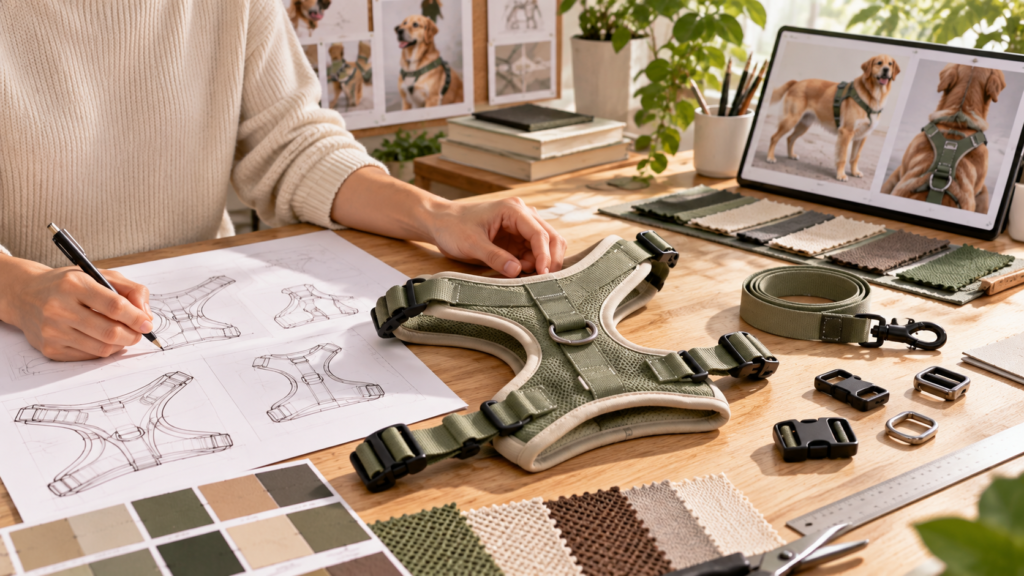
5. Made to Measure Dog Harness vs. Standard Adjustable Sizes
Not every brand needs a separate pattern for every dog.
In fact, for most wholesale and private-label collections, producing individually measured harnesses would increase pattern-making, inventory, and production costs.
A made to measure dog harness may be suitable for specialist applications, such as unusual body proportions or certain working-dog requirements. However, it is a different business model from producing adjustable retail sizes.
For most brands, a better starting point is to develop a carefully tested range with practical adjustment options.
When Does Bespoke Sizing Make Sense?
Brands may consider bespoke harness sizing when their existing range repeatedly fails to fit a particular customer group.
For example, a brand specializing in broad-chested, short-legged dogs might discover that extending the straps is not enough to improve the fit.
The solution could be a separate body pattern with a shorter chest panel and different strap positioning, rather than adding another standard size.
Before investing in this type of development, we recommend reviewing customer feedback and asking:
- Are customers complaining about the same part of the harness?
- Do certain body types consistently fall between two sizes?
- Can strap adjustments solve the issue, or does the pattern need changing?
- Is there enough demand to justify an additional product variant?
These questions help brands distinguish between a genuine design problem and a problem caused by unclear size selection.
6. Real Case Study: Why Harness Strength Alone Is Not Enough
A custom size dog harness needs more than accurate dimensions. Its materials, construction, and intended use must also be considered.
One useful industry example comes from the Center for Pet Safety’s testing of the Allsafe vehicle-restraint harness.
The Allsafe Harness Testing Case
In its 2013 Allsafe Harness case study, the Center for Pet Safety examined a harness that had been developed for securing dogs in vehicles.
The product demonstrated considerable structural strength. However, its original extension tether arrangement did not keep the crash-test dog on the seat throughout testing.
During follow-up testing, the connection method was changed. Removing the extension tether and routing the vehicle seat belt through the harness improved restraint performance in the reported tests.
This case is about automotive safety harnesses, not ordinary walking harnesses, and the two applications have different testing requirements.
Nevertheless, it highlights an important product-development lesson:
A strong component does not guarantee that the complete product will perform correctly.
For everyday walking harnesses, brands should therefore look beyond the breaking strength of the webbing.
They also need to check whether the straps stay correctly positioned, whether the harness twists under pulling, and whether the fittings operate reliably during normal use.
For car-restraint products, separate crashworthiness validation is necessary. Ordinary pull testing is not proof of crash protection.
7. From Sample Approval to Reliable Bulk Production
A sample may look excellent on a table and still fit poorly once a dog starts moving.
That is why we recommend testing the first sample on real dogs before approving the full size range.
Ideally, brands should include dogs with different chest shapes and proportions, rather than testing only one breed.
A useful fitting trial involves observing the dog while standing, walking, turning, and moving at a comfortable trot.
Check for strap movement, rubbing, pressure around the chest, and how easily the harness can be adjusted.
Research also supports the importance of checking movement. A 2019 study in Veterinary Record found that different harness designs could affect shoulder extension during walking and trotting. This does not mean one design is automatically best for every dog, but it reinforces the value of testing actual movement.
What Should Buyers Check Before Approving Production?
We suggest recording the following results during sample development and pre-production inspection.
| Inspection Item | Recommended Check |
|---|---|
| Finished dimensions | Compare each sample against approved measurement specifications |
| Fit and movement | Check strap positioning, rubbing, twisting, and adjustment on real dogs |
| Stitching quality | Inspect reinforcement, loose threads, skipped stitches, and seams |
| Hardware performance | Conduct agreed buckle, D-ring, and connection-point tests |
| Size consistency | Check the smallest, middle, and largest sizes, including adjustment limits |
| Label accuracy | Confirm that the hangtag, packaging, and online size chart match the finished product |
The buyer and manufacturer should agree on test methods, performance limits, and dimensional tolerances before production. These should not be left to interpretation during final inspection.
After the sample is approved, the final custom dog harness measurements should be recorded in the production specification together with material details, hardware requirements, and construction notes.
This gives the production team a clear reference for each size.
For more information about how buyers can approach inspection, read our guide to custom dog bag quality control.
8. How Aimazing Helps Brands Develop Better Harness Sizing
For pet brands, getting the size range right is a balance between customer comfort, product reliability, and production cost.
At Aimazing Bag, we have worked in functional bag manufacturing since 2000, supporting brands with OEM and ODM product development.
When developing a new custom pet harness collection, we can work with buyers to review pattern measurements, choose appropriate materials and hardware, prepare samples, and refine construction details before production.
Our development support includes reviewing adjustment points, reinforcement requirements, logo placement, and packaging specifications.
We also help brands consider whether a standard adjustable collection is sufficient or whether bespoke harness sizing would better serve their target customers.
For suitable projects, our MOQ starts from 100 pieces, with sampling typically available in 3–5 days once the necessary specifications and materials are confirmed. More complex designs may require additional development time.
You can learn more about our OEM/ODM customization process and how we work with pet brands from initial ideas through production.
Conclusion: Better Sizing Starts Before Production
A reliable harness sizing system does not come from adding more sizes to a product catalog.
It comes from understanding the dogs your customers own, collecting consistent measurements, testing real samples, and making sure the factory follows the approved specifications.
A practical size chart also helps customers choose the right product and gives retailers clearer information when handling sizing questions.
If your brand is planning a new custom size dog harness collection, Aimazing can help you review the design, develop samples, and prepare a suitable sizing plan for manufacturing.
Contact our team to discuss your drawings, target market, expected order quantity, and product requirements. We would be happy to explore a practical solution together.