1. Kinetic Realities: Why Static Weight Ratings Fail Modern Pet Carrier Engineering
Dynamic live-load G-force amplification invalidates static laboratory weight ratings during real-world animal transport. When brand developers evaluate a commercial pet carrier handle load test, static dead-weight measurements fail to account for sudden animal movements that generate multi-axial kinetic shocks. A stationary twenty-pound pet creates dynamic impact forces exceeding one hundred pounds of equivalent tension during airport baggage drops or vehicle braking maneuvers. Factory soft-goods engineers must design load-bearing architectures that withstand these aggressive kinetic acceleration spikes rather than relying on basic static mass calculations. Standardizing dynamic stress parameters is the only reliable method for preventing catastrophic structural failures across international distribution channels.
| Kinetic Load Factor | Laboratory Testing Parameter | Structural Engineering Impact |
| G-Force Amplification | Multi-axial kinetic shock simulation | Exceeds static weight assumptions significantly |
| Braking Maneuvers | Equivalent tension thresholds | Requires high-tenacity webbing skeletons |
| Impact Acceleration | Sudden animal repositioning loads | Prevents catastrophic structural failure |
2. Tensile Webbing Dynamics: Specifying Extreme Pet Carrier Strap Strength
High-denier nylon and ballistic polyester straps reach their ultimate breaking thresholds when subjected to unrelenting multi-directional tension cycles. Specifying correct tensile webbing requires auditing fiber denier counts, weave density, and yarn twist parameters to prevent catastrophic tearing under load. When a bag undergoes a rigorous pet carrier strap strength test, industrial tension machines pull webbing strips until structural failure occurs. Factory technicians utilize these breaking point datasets to select heavy-duty strapping materials that exceed standard retail safety requirements. Ensuring superior strap integrity protects active pet owners from sudden carrying failures during crowded urban commutes.
- Primary Question: What technical specifications determine the breaking thresholds of high-denier transit bag straps?
- Direct Answer: Fiber denier counts, weave density, and yarn twist parameters directly determine the ultimate breaking thresholds of transit webbing.
- Complementary Explanation: Executing a strict pet carrier strap strength test identifies tearing points under unrelenting tension, ensuring selected materials exceed safety norms.
3. Chassis Mass Physics: Calculating Safe Operational Pet Bag Load Capacity
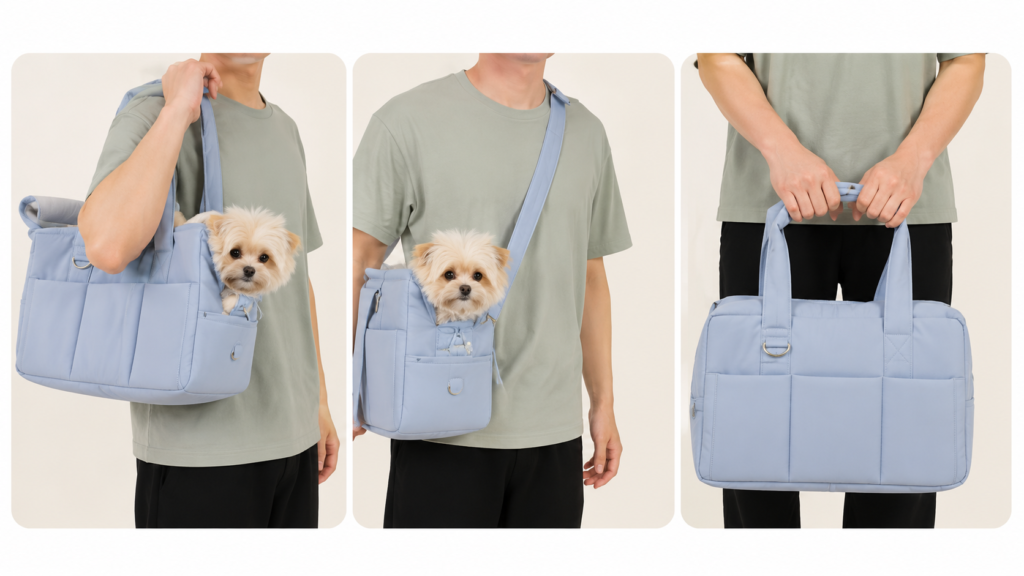
Accurate core calculations balance maximum animal mass against internal structural rigidity to eliminate sagging floors and animal distress. Determining a reliable pet bag load capacity requires analyzing base-plate deflection mechanics and material yield strengths under continuous vertical pressure. Sagging, unsupported floors force pets into cramped, stressful postures that turn transit into an endurance test. Smart structural engineering fixes this by locking in multi-ply composite baseboards that evenly distribute live weight across the entire chassis. Backing this up with a rigorous pet carrier handle load test ensures total structural integrity, protecting pet health and keeping your products performing flawlessly under real-world pressure.
- Primary Question: How do base-plate deflection mechanics influence animal comfort and structural integrity in transit bags?
- Direct Answer: Base-plate deflection mechanics determine whether a floor sags under live weight, directly impacting animal posture and comfort.
- Complementary Explanation: Calculating a safe pet bag load capacity requires integrating rigid multi-ply composite base boards that distribute weight uniformly and eliminate floor sagging.
4. Stress Convergence Architecture: Advanced Pet Carrier Handle Reinforcement Engineering
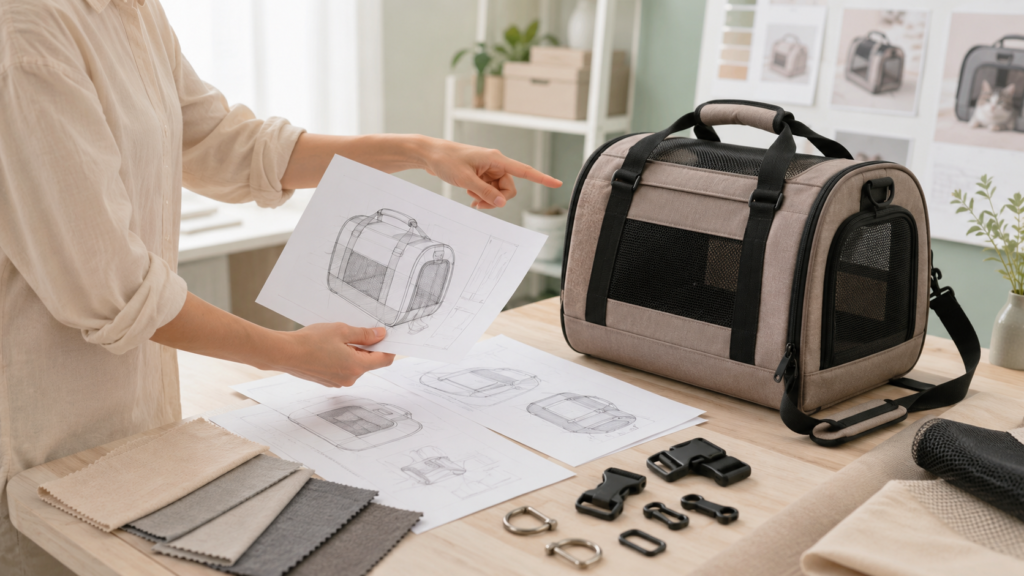
Multi-needle box-X stitching layouts and high-density interior webbing reinforcement patches neutralize stress convergence at critical handle connection junctures. Strategic pet carrier handle reinforcement channels gravitational weight evenly across the entire soft-goods frame instead of ripping isolated fabric panels. When a heavy animal load pulls upward on a handle, kinetic forces concentrate intensely at the stitching perimeters. Factory technicians apply industrial bar-tack machinery to distribute this concentrated energy across a wider structural surface area. Advanced engineering architecture guarantees multi-year operational longevity across demanding global retail markets.
- Primary Question: How do advanced stitching layouts prevent fabric tearing at critical handle connection points?
- Direct Answer: Multi-needle box-X stitching layouts and high-density interior webbing patches neutralize stress convergence by distributing weight evenly.
- Complementary Explanation: Executing precise pet carrier handle reinforcement channels gravitational pull across the entire soft-goods frame instead of tearing isolated panels.
5. Stress Convergence Architecture: Maximizing Critical Pet Bag Seam Strength
Bound edge constructions and multi-stitch rows create impenetrable tear propagation barriers that prevent zipper blowouts and panel separation under heavy loads. Maximizing critical pet bag seam strength requires precise thread tension calibration and high-tenacity bonded nylon thread utilization. A clawing, thrashing pet puts extreme multi-directional stress on interior seams. High-end assembly lines tackle this by pairing double-needle lockstitching with clean, folded edge bindings that completely lock down raw fabric. Putting a design through a rigorous pet carrier handle load test and seam-stress audit proves that the enclosure stays rock-solid and completely intact through thousands of brutal travel cycles.
- Primary Question: What assembly techniques create effective tear propagation barriers along transit bag seams?
- Direct Answer: Bound edge constructions and multi-stitch rows encapsulate raw fabric edges to prevent zipper blowouts and panel separation.
- Complementary Explanation: Maximizing pet bag seam strength requires precise thread tension calibration and multi-stitch lockstitching to withstand multidirectional shear stress.
6. Comprehensive Lifecycle Validation: Implementing Strict Pet Carrier Durability Testing
Subjecting production samples to automated cyclic drop tests, abrasion simulations, and tensile stress evaluations validates long-term product survivability. Implementing strict pet carrier durability testing uncovers hidden manufacturing defects before goods reach international retail shelves. Simulating years of aggressive consumer use in a matter of days ensures that soft-goods withstand the harshest travel environments. Factory testing laboratories maintain strict environmental controls to replicate extreme temperature and humidity conditions during testing cycles. Comprehensive validation protocols elevate standard manufacturing into elite engineering excellence.
- Primary Question: How do simulated laboratory drop and abrasion tests validate the long-term lifecycle of transit bags?
- Direct Answer: Automated drop tests and abrasion simulations replicate years of aggressive consumer use to uncover hidden manufacturing defects.
- Complementary Explanation: Implementing strict pet carrier durability testing ensures soft-goods withstand harsh travel environments before reaching retail distribution.
7. Scalable OEM Execution: Partnering for Precision Soft-Goods Manufacturing Excellence
Rigorous break-force tests, dead-on pull-force meters, and strict stitch-count checks are non-negotiable for locking down mass-production quality. Collaborating with seasoned manufacturing partners turns complex structural load requirements into high-margin catalog staples through expert technical engineering. Aimazing Bag equips global brands to scale production with zero guesswork, backed by bulletproof quality consistency. Streamlined material procurement and optimized freight cube math guarantee on-time shipments straight to international distribution centers. Locking in a professional production partnership secures total supply chain excellence from initial prototype to final dock delivery, putting your pet carrier handle load test metrics safely over the finish line.