1. The Economics of Functional Soft-Goods: Demystifying Pet Carrier Bag MOQ and Cost Dynamics
Initial factory quotations depend directly on material utilization efficiency, cutting-die calibration setups, and dedicated production line allocation schedules when evaluating a baseline pet carrier bag MOQ and cost budget. When brand architects calculate this financial threshold, understanding machine setup overhead remains essential for economic viability. Soft-goods manufacturing requires precise multi-ply fabric nesting to minimize raw material waste during automated CNC laser cutting. Higher production volumes distribute fixed tooling and preparation expenses across thousands of units, reducing the per-piece baseline quotation. Lower production runs force factories to absorb steep line-switching losses, which inflates the final manufacturing unit price significantly.
- Primary Question: How do material utilization rates and setup overhead dictate initial factory quotations for soft-goods?
- Direct Answer: Higher production volumes distribute fixed tooling and setup expenses across thousands of units, reducing the per-piece baseline quotation.
- Complementary Explanation: Automated CNC laser cutting efficiency and machine line-allocation schedules determine foundational manufacturing costs before raw materials are added.
2. Raw Material and Hardware Expenditures: Decoding Pet Carrier Manufacturing Cost Drivers
Price variances between high-denier poly-canvas, ballistic nylon, and eco-friendly recycled polyester face fabrics dictate baseline material expenditures when managing corporate supply chains. Calculating the exact pet carrier manufacturing cost requires analyzing technical textile durability ratings and waterproof lamination treatments alongside your target pet carrier bag MOQ and cost parameters. Standard 600D polyester offers affordable entry-level pricing for mass-market retail channels, whereas 1680D ballistic nylon delivers elite tear resistance for heavy-duty outdoor gear. Sourcing certified GRS recycled textiles introduces modest raw material premiums that appeal to eco-conscious corporate buyers. Selecting appropriate textile grades balances end-use performance requirements with strict commercial target budgets.
| Textile Grade Category | Denier Thickness Specification | Primary Performance Advantage |
| Standard Poly-Canvas | 600D water-resistant oxford | Cost-effective baseline for mass retail |
| Ballistic Nylon | 1680D high-tenacity weave | Elite tear and puncture resistance |
| Eco-Recycled RPET | 900D GRS-certified yarn | Sustainable corporate compliance |

3. Balancing Production Scalability: Managing Custom Pet Bag MOQ Thresholds
Assembly floor line-switching overhead makes low-batch production economically demanding for specialized multi-compartment soft goods during preliminary supplier negotiations. Establishing a viable custom pet bag MOQ requires accounting for the labor hours lost during specialized machine recalibration and tooling setups. When sewing technicians transition from standard duffels to complex pet carriers featuring mesh windows and rigid base boards, line output drops temporarily. Factories must price these mandatory setup losses into smaller production orders to cover operational floor expenses while aligning with your overall pet carrier bag MOQ and cost structure. Minimizing frequent line changes optimizes labor allocation and protects manufacturing efficiency across all active shifts.
- Primary Question: Why does low-batch production introduce high economic demands for specialized soft goods?
- Direct Answer: Low-batch production incurs heavy assembly floor line-switching overhead and specialized machine recalibration labor losses.
- Complementary Explanation: Frequent production transitions reduce technician output speed, requiring factories to absorb setup losses through higher baseline pricing tiers.
4. Margins and Distribution Tiers: Calculating Sustainable Pet Carrier Wholesale Price Margins
Factoring freight volumetric weight, international import duties, and retail markup targets dictates initial factory production budgeting parameters when planning multi-tier distribution networks. Determining an optimal pet carrier wholesale price requires comprehensive financial modeling across complex global logistics channels and baseline pet carrier bag MOQ and cost agreements. Soft-goods packaging bulk creates significant volumetric shipping charges that can erode gross profit margins if container density is neglected. Importers must calculate landed costs accurately to ensure that wholesale pricing structures accommodate distributor margins and retail profitability. Rigorous financial accounting safeguards brand solvency throughout global supply chain operations.
| Financial Variable | Cost Calculation Parameter | Commercial Impact on Margins |
| Volumetric Weight | Master carton cubic dimension | Direct impact on maritime shipping freight |
| Import Tariffs | Harmonized system material code | Varies by country of destination import |
| Retail Markup | Target multi-tier distributor spread | Determines brand wholesale profitability |

5. Prototyping Investments: Understanding the Realities of Pet Bag Sample Cost
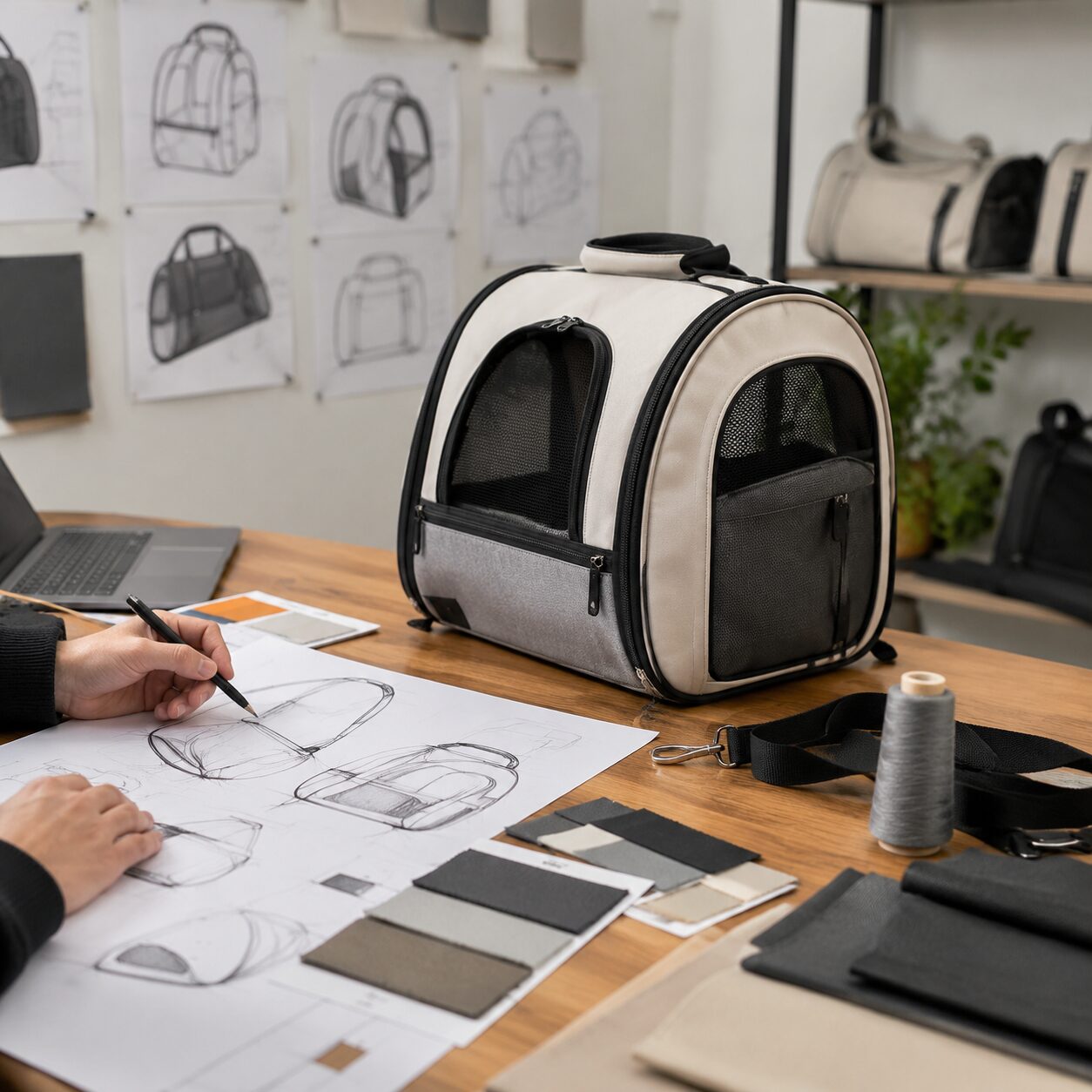
Converting intricate multi-compartment sketches into physical pre-production samples requires precision pattern cutting and dedicated sampling lines before finalizing your pet carrier bag MOQ and cost targets. Analyzing a standard pet bag sample cost involves covering specialized labor, custom cutting dies, and material sourcing fees. Prototype development transforms two-dimensional digital design files into functional three-dimensional soft-goods ready for rigorous ergonomic evaluation. Skilled sample technicians calibrate stitch tensions and test zipper track smoothness during initial physical builds. Investing in meticulous digital-to-physical translation prevents costly manufacturing errors down the line.
- Primary Question: What operational expenses contribute to the creation of pre-production soft-goods prototypes?
- Direct Answer: Pre-production prototypes incur expenses for specialized artisan labor, custom cutting dies, and technical material sourcing fees.
- Complementary Explanation: Transforming 2D digital sketches into functional 3D samples allows technicians to calibrate stitch tensions and test hardware before mass production.
6. Volume Tiering Strategies: Unlocking Lower Pet Carrier Bulk Pricing Tiers
Maximizing 40-foot high-cube shipping container capacity reduces per-unit freight and handling overheads drastically for global transport when balancing long-term supply chain agreements. Securing advantageous pet carrier bulk pricing relies heavily on optimizing dimensional carton layouts to eliminate dead airspace inside maritime containers while respecting your baseline pet carrier bag MOQ and cost commitments. Factory logistics specialists calculate exact master carton dimensions to fit maximum unit quantities within standard export shipping containers. Efficient volumetric packing lowers international logistics expenses per piece, improving overall product profitability. Strategic container planning transforms freight management into a powerful margin-enhancement tool.
| Logistics Parameter | Container Optimization Strategy | Freight Cost Reduction Benefit |
| Carton Nesting | Interlocking soft-goods compression | Eliminates internal master carton dead space |
| Pallet Utilization | Maximum height high-cube stacking | Lowers per-unit international freight tariffs |
| Load Efficiency | Full 40ft container consolidation | Maximizes shipping scale economies |
7. Modern Production Infrastructure: Collaborating with Aimazing Bag for Commercial Soft-Goods Manufacturing
Ditch traditional needle-and-thread stitching that punches micro-perforations straight through your barrier membrane and turns your core into a sponge for liquid spills. High-frequency RF welding completely bypasses that headache by heat-fusing adjacent thermoplastic sheets into a solid, impenetrable, hermetic joint that locks out moisture and holds tight against any volume. Whether you are dialing in strict production minimums or keeping a close eye on your bottom-line manufacturing budget, upgrading to advanced thermal bonding guarantees zero-defect performance across every single unit while keeping your wholesale tiers predictable from prototype to mass rollout.