The 2026 U.S.–China “30-for-30” framework has quickly attracted attention from importers, sourcing teams and consumer-product brands.
For companies involved in pet product sourcing, however, the most important point is also the easiest one to misunderstand:
The framework does not mean that pet travel bags, pet harnesses or pet training bags have already received lower U.S. tariffs.
The United States and China have approved two product lists covering roughly $30 billion of bilateral trade on each side, with the goal of considering more favorable tariff treatment for selected non-sensitive goods. Any actual tariff reductions must still be determined and implemented through each country’s domestic legal procedures.
The current U.S. import list contains 77 tariff lines, including household products, textiles, appliances, toys, sporting goods and other consumer products. Pet travel bags, pet harnesses and similar pet soft goods are not specifically included on that published list.
For U.S. pet brands, then, the real question is not:
“Have tariffs on pet products already fallen?”
It is:
“Does the 30-for-30 framework signal a different direction for U.S.–China consumer-goods trade, and how should pet brands prepare if that direction continues?”
That is where the framework becomes relevant to long-term pet product sourcing.
1.What Is the U.S.–China “30-for-30” Framework?
The “30-for-30” framework was formally announced on September 27, 2026 under the newly established U.S.–China Board of Trade.
Its basic concept is relatively simple.
The United States and China have each approved a list of goods representing roughly $30 billion in annual bilateral trade, using 2024 trade values as the reference point. These products are being considered for reciprocal, more favorable tariff treatment.
This makes the framework different from a broad tariff rollback covering all Chinese consumer goods.
It is a targeted product mechanism.
Rather than changing tariffs across entire economies at once, the two governments can identify selected non-sensitive products for different treatment.
USTR described the initial recommendations as covering approximately $30 billion of non-sensitive goods on each side that could qualify for better tariff treatment in the future.
Three points are especially important for importers.
(1). The product lists have been approved, but the tariff cuts are not automatically effective.
The official terms state that future tariff reductions involving products on the approved lists will be determined and implemented according to each side’s domestic legal procedures.
So importers should not simply change their landed-cost calculations because a product appears in the framework.
Implementation matters.
(2). The framework currently covers selected products, not entire industries.
The U.S. list contains 77 HTS tariff lines.
That means eligibility is determined by specific tariff classification, not by broad descriptions such as “consumer goods,” “textiles” or “pet products.”
(3). The framework can potentially expand.
The official terms allow the two sides to discuss adding additional products in the future and to make proposals for adjustments. The parties do not currently expect adjustments more frequently than annually.
This third point is the one pet-product buyers should watch most closely.
2.Are Pet Products Included in the Current 30-for-30 List?
At present, buyers should not assume that pet bags, harnesses or training bags are covered.
The published U.S. list includes products such as household textiles, household appliances, toys, sporting goods and vacuum containers, among other categories.
But the list does not contain the major 4201 or 4202 headings commonly relevant to many animal harnesses, bags and similar soft-goods products.
This matters because tariff treatment follows the actual HTS classification of a product—not its marketing name.
A product sold online as a “pet travel bag,” for example, cannot be assumed to receive the same customs treatment as another travel-related pet accessory.
Its materials, construction, intended use and design can affect classification.
Therefore, the immediate result of the 30-for-30 announcement is not lower tariffs for pet products.
The more important development is structural:
The two governments have created a formal mechanism for selecting certain non-sensitive goods for potentially more favorable tariff treatment.
That may affect how U.S. brands think about pet product sourcing China over the next several years.
3.PAST: High Tariffs Made Cost the Main Sourcing Question
In the previous tariff environment, many U.S. importers focused heavily on one problem:
How do we control landed cost?
For pet-product brands, that affected far more than customs paperwork.
High tariffs could influence:
- target FOB prices;
- material choices;
- product specifications;
- retail pricing;
- order quantities;
- supplier diversification;
- and margin planning.
As a result, many sourcing conversations became centered on reducing cost.
Can the fabric weight be reduced?
Can the buckle be replaced?
Can one pocket be removed?
Can packaging be simplified?
Can production be moved somewhere else?
This cost pressure did not disappear in 2026.
But the 30-for-30 framework introduces a different question.
Instead of assuming that U.S.–China trade will remain under one fixed tariff structure indefinitely, sourcing teams now have another policy mechanism to monitor.
4.NOW: A More Selective Tariff Structure Is Emerging
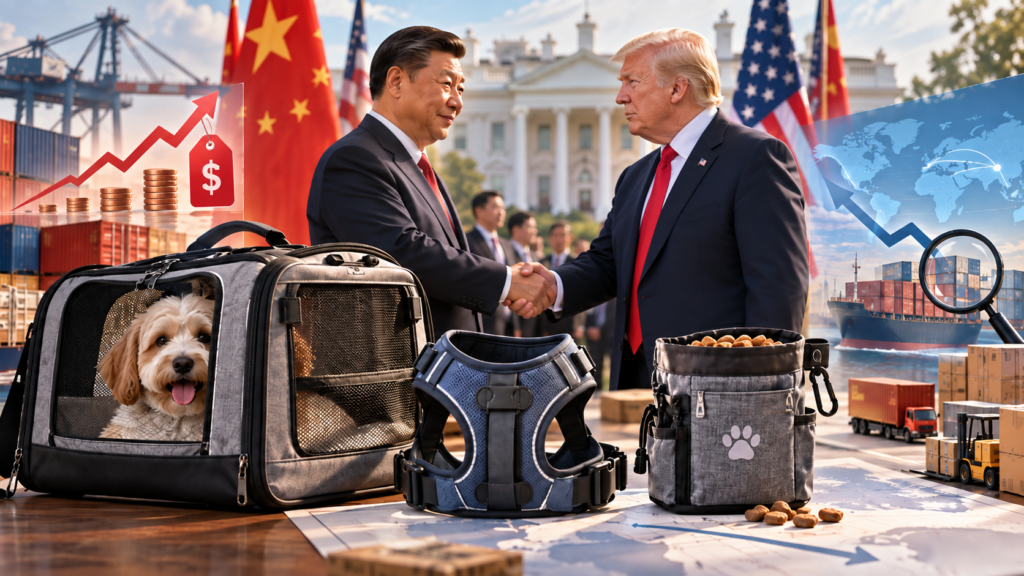
The biggest significance of “30-for-30” may therefore be the method, not the first product list.
The initial framework separates selected non-sensitive goods from the broader tariff relationship and creates a process through which those goods may receive more favorable treatment.
That does not amount to full normalization of U.S.–China trade.
Nor does it mean all consumer products will eventually receive tariff reductions.
But it creates a more selective structure than a simple blanket approach.
For pet accessories sourcing, this is worth watching because many pet products are consumer lifestyle goods rather than strategically sensitive industrial products.
That alone does not make them eligible for future inclusion.
However, if future negotiations continue expanding the range of non-sensitive products covered by the framework, pet-product companies may eventually need to reassess the economics of sourcing from China.
The correct strategy today is therefore not to predict a tariff cut.
It is to prepare for more than one possible tariff environment.
5.NEXT: Why Future Product-List Expansion Matters
The current 77-line U.S. list should not be viewed as the final shape of the framework.
The official terms explicitly provide for discussion of future expansion.
For U.S. brands, this creates three possible scenarios.
Scenario 1: Pet products remain outside the framework
In this case, existing tariff treatment continues to be an important part of landed-cost calculations.
Brands should continue focusing on cost engineering, supplier efficiency and product value.
Scenario 2: Selected pet-related tariff lines are included later
If that happens, the commercial impact could vary significantly by HTS classification.
One category might benefit while another remains unchanged.
This means buyers need accurate classifications for each SKU rather than treating their entire pet collection as one tariff category.
Scenario 3: The framework expands gradually across more consumer goods
This would potentially make China sourcing economics more attractive for certain categories.
But the brands best positioned to benefit would be those that already understand their cost structure, supplier capabilities and product-development pipeline.
Waiting for a tariff announcement before rebuilding a supply chain would leave very little time to respond.
6.What This Means for Pet Travel Bags, Harnesses and Training Bags
For now, the implications for these products are strategic rather than immediate.
A custom pet travel bag, custom pet harness or pet training bag should still be sourced according to its current tariff classification and actual landed cost.
But companies involved in pet travel bag sourcing and pet harness sourcing should start maintaining clearer SKU-level cost models.
For each product, brands should understand:
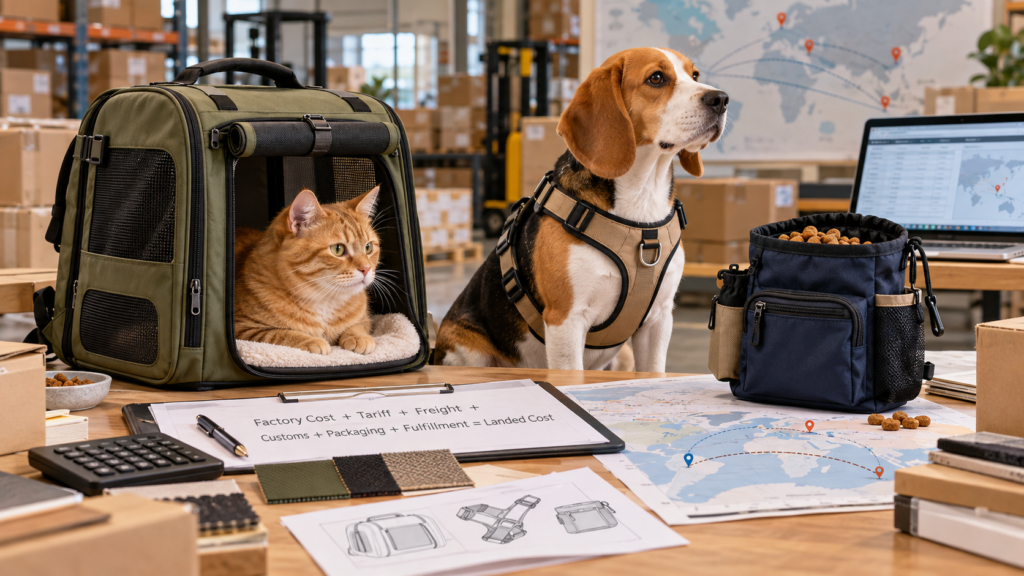
Factory Cost + Tariff + Freight + Customs + Packaging + Fulfillment = Landed Cost
If tariff treatment changes later, companies can immediately identify which products benefit and how much commercial room that creates.
That room might be used to:
- improve materials;
- add features;
- protect retail margin;
- lower retail pricing;
- increase marketing spend;
- or develop additional SKUs.
This is why the most useful response to the 30-for-30 framework is not immediately changing suppliers.
It is improving visibility over the supply chain.
7.From Tariff Reaction to Product Architecture
The next stage of pet product sourcing may require brands to think less about isolated quotations and more about product architecture.
For example, a pet brand might develop:
Pet Travel Bag → Harness → Leash → Training Bag
as one coordinated collection.
Shared fabrics, webbing, hardware, colors and packaging can make the supply chain more efficient.
If future tariff changes affect one product differently from another, the brand can adjust its assortment rather than redesigning the entire collection.
This is a more flexible response than simply chasing whichever country has the lowest tariff at one point in time.
It also explains why pet product development and tariff strategy are increasingly connected.
8.Why a Product Development Partner Matters More in an Uncertain Tariff Environment
The traditional manufacturer relationship usually begins after the buyer has completed the design.
The buyer sends specifications.
The factory quotes.
The factory produces.
That model works when the product and commercial environment are stable.
But when tariffs, freight, materials and retail price expectations can change, brands need more flexibility earlier in the development process.
A pet product development partner can help buyers evaluate:
- material alternatives;
- construction changes;
- target cost;
- SKU architecture;
- shared components;
- production feasibility;
- and different cost scenarios.
For a pet product supplier China, the value is therefore no longer limited to producing a finished design.
The supplier can become part of the commercial development process.
At Aimazing, this is how we approach custom pet-product projects.
Rather than looking only at how a bag or harness can be manufactured, we also consider how its materials, structure, production method and related SKUs can work together as a scalable collection.
That becomes especially important when the tariff environment is still evolving.
9.What U.S. Pet Brands Should Watch Next
The 30-for-30 announcement should be treated as the beginning of a process rather than the final tariff outcome.
For sourcing teams, four areas now deserve attention.
Products appearing on the approved lists should not be treated as automatically receiving lower tariffs until the relevant domestic legal procedures are completed.
Second, watch future product-list expansion.
The framework formally leaves room for additional products.
Third, review HTS classifications now.
If future policy changes affect specific tariff lines, companies with accurate SKU-level classification data will be able to respond much faster.
Fourth, model multiple sourcing scenarios.
China sourcing should not be evaluated only under today’s tariff rate or an assumed future reduction.
Buyers should model both.
10.The Real Opportunity Is Greater Predictability
The 2026 “30-for-30” framework does not currently provide a direct tariff benefit for pet travel bags, harnesses or training bags.
That is the first point pet-product buyers need to understand.
But it would also be too narrow to dismiss the framework simply because pet products are not on the initial list.
Its broader importance is that the United States and China have established a mechanism through which selected non-sensitive products may receive different tariff treatment, with future expansion explicitly remaining possible.
That changes the strategic conversation.
PAST
High tariffs made cost reduction the central sourcing issue.
NOW
The 30-for-30 framework introduces a selective mechanism for potentially more favorable treatment of certain non-sensitive goods.
Pet products are not automatically covered.
NEXT
Pet brands need to watch whether the framework expands while improving their own:
- product architecture;
- landed-cost visibility;
- supplier strategy;
- SKU planning;
- and product-development capability.
The real opportunity is therefore not simply paying less tariff.
It is using a potentially more predictable sourcing environment to build better products, stronger collections and a more flexible supply chain.
For U.S. pet brands, that may ultimately prove more valuable than any single tariff reduction.